
Why My First Attempt at OpenClaw Was a Total Disaster
TL;DR
Building agentic systems isn’t about the LLM; it’s about the runtime. My journey through OpenClaw taught me that a “capability” is useless without a “policy.” To move from lab experiments to enterprise reality, we must stop learning how to “prompt” and start learning how to govern, permission, and orchestrate.
Over the last few days, I dove back into Aishwarya & Kiriti’s OpenClaw Mastery Labs. If I’m being honest, my first attempt months ago was total chaos. I eventually walked away when security vulnerabilities pulled the last string, forcing me to get my “hands off the Claw.”
But this time, I took the liberty of deliberately breaking, bending, and stressing the system. Thanks to Aishwarya Naresh Reganti and Kiriti Badam for the OpenClaw course.
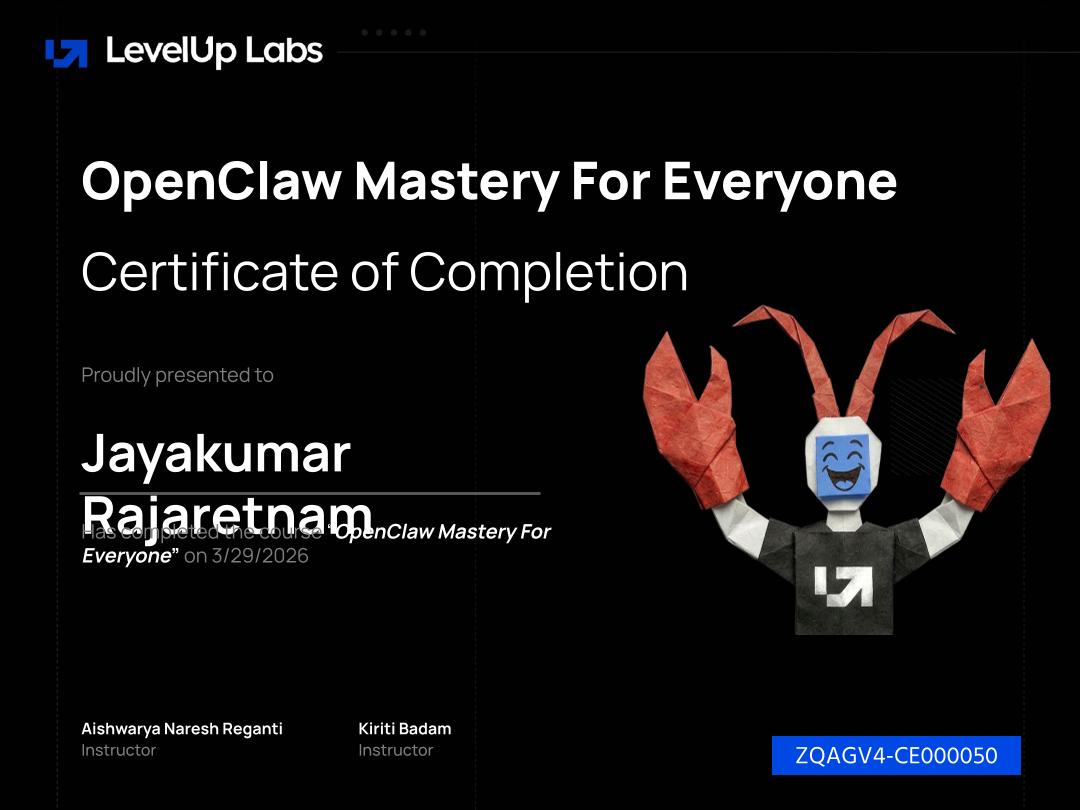
OpenClaw is not a tool to be “learned.”
It is an environment to be experienced. Unless you engage with it by breaking it, you’ll walk away with a superficial understanding. That, too, at a time when architectural depth is the only real differentiator for AI professionals.
The Reality of the “Build”
The course covers the essentials:
- Setting up OpenClaw in a controlled environment
- Adding channels (Telegram, email)
- Wiring skills (search, email, summaries)
- Progressing toward multi-agent orchestration
If you follow the path linearly, you’ll end up with a working system and a sense of satisfaction to brag about to your friends. But that is not where the real learning begins. I decided to take the scenic route:
- Runtime Friction: I started with the wrong runtime (Ubuntu vs. Docker) and rebuilt. It forced an early realization: Runtime context is everything. Whether something runs on the host or inside a container isn’t an implementation detail. It defines configuration, permissions, and execution behavior.
- Model Switching: I swapped models midway, testing Anthropic, Gemini, and OpenAI just to understand token usage, quality vs. efficiency, and the “friction” each provider introduces to the agent’s logic.
- The 1 AM Debug: I spent late nights debugging heartbeats, gateways, and container context. Not because I had to, but because I wanted to see how the system worked.
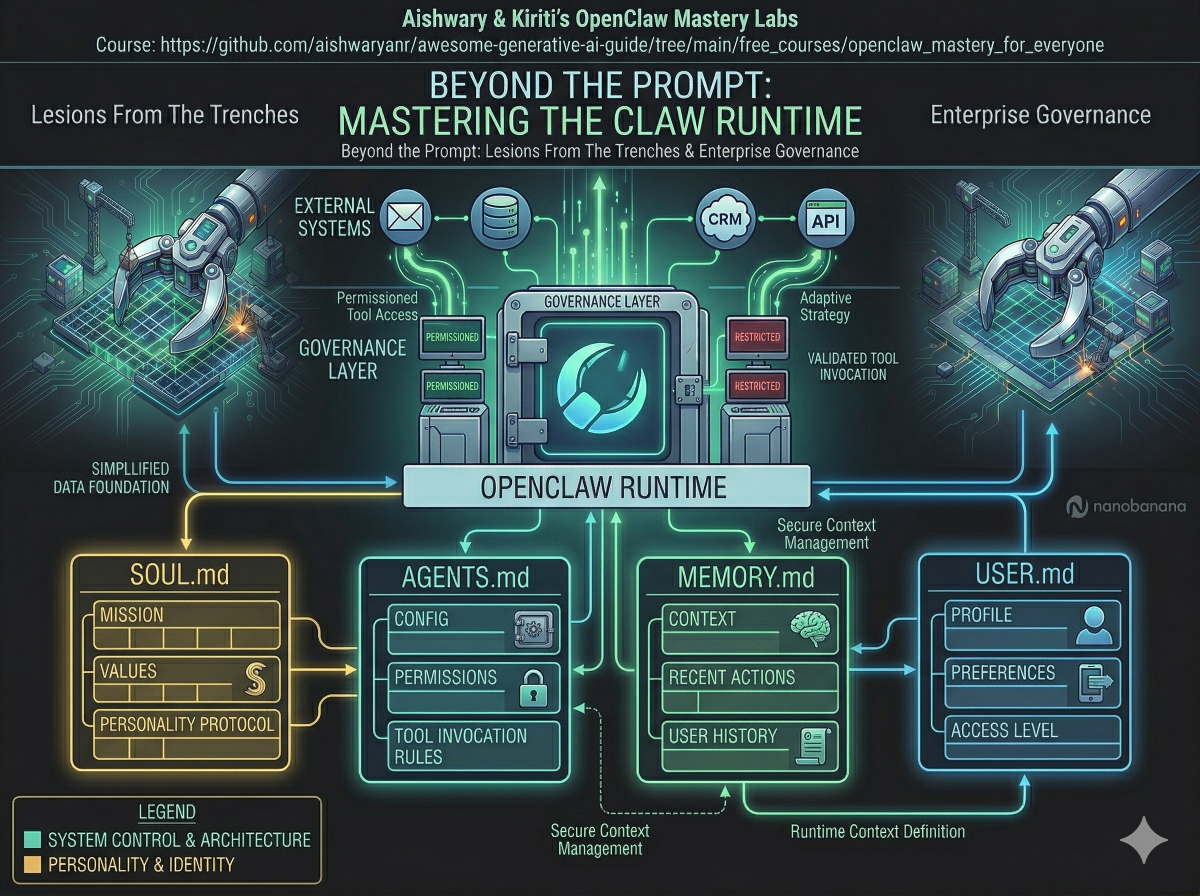
When “It Works in the Terminal” Is Not Enough
One of the most instructive moments came during the transition from simple scripts to agent-executable tools. I could get things working in the terminal without issue. APIs responded. Scripts executed.
But when the agent tried to invoke that same functionality, it failed. This is where OpenClaw reveals its true nature:
- A script is not a capability.
- A capability is not a tool.
- A tool is unusable unless it is explicitly exposed, permissioned, and structured for agent invocation.
This is all governed by AGENTS.md, which quickly became the most important and frustrating component of the system. Permissions had to be defined with surgical precision. Too restrictive, and nothing worked. Too loose, and you lost control. That tension is the core design principle of agentic AI.
From Intelligence → Execution
If you’ve followed my earlier posts, you know my POV:
We are shifting from “AI that thinks” to “AI that does.”
In case you missed my earlier posts, here are the links:
The hard part isn’t capability. It’s control, permissions, and orchestration. This course makes that very clear:
- Skills ≠ Tools unless properly exposed and permitted.
- Agents ≠ Scripts unless governed by policy.
- Automation ≠ Scale unless you master the runtime context.
My Advice:
Don’t do this course once and move on. If you do, you’re under the illusion of completion. Do it again (and again). Build/learn iteratively. To leverage “the Claw” for enterprise use cases, you need to treat each run as a system design exercise:
- Spin up a fresh VPS (or a local setup)
- Change your “soul” and instruction design
- Pick a different model provider
- Push the boundaries of permissions and delegation
Why This Matters
What we’re seeing today is “lab mode.” But by the end of 2026, the outcome will be enterprise reality: agents operating across email, CRM, and internal files, acting within controlled, auditable environments.
The organizations (and individuals) that experiment deeply now will be the ones that successfully orchestrate agentic systems later.
Don’t just learn OpenClaw. Learn how to control it, break it, and rebuild it.
Check out the Free, 10-day LevelUp Labs course here: OpenClaw Mastery