When AI Starts Building Itself, Your Operating Model Is the Bottleneck
Anthropic engineers today ship 8x the code per quarter they did in 2024. More than 80% of code merged into their production codebase is now authored by Claude. This is May 2026. Early data from the field, according to a new McKinsey report on agentic delivery models confirms this—leading organizations are already realizing 3x to 5x productivity gains alongside a 60% reduction in core team sizes.
These gains aren’t coming from simply giving employees better AI tools. They are the result of aggressively rewiring the corporate operating model so humans and autonomous agents can collaborate seamlessly.
Anthropic’s recent research on recursive self-improvement underscores the urgency of this moment: operating models built for human speed cannot survive an environment where machines learn and optimize faster than teams can adapt.
To capture this value, leadership teams must navigate a complex matrix of moving bottlenecks and rewritten workflows.
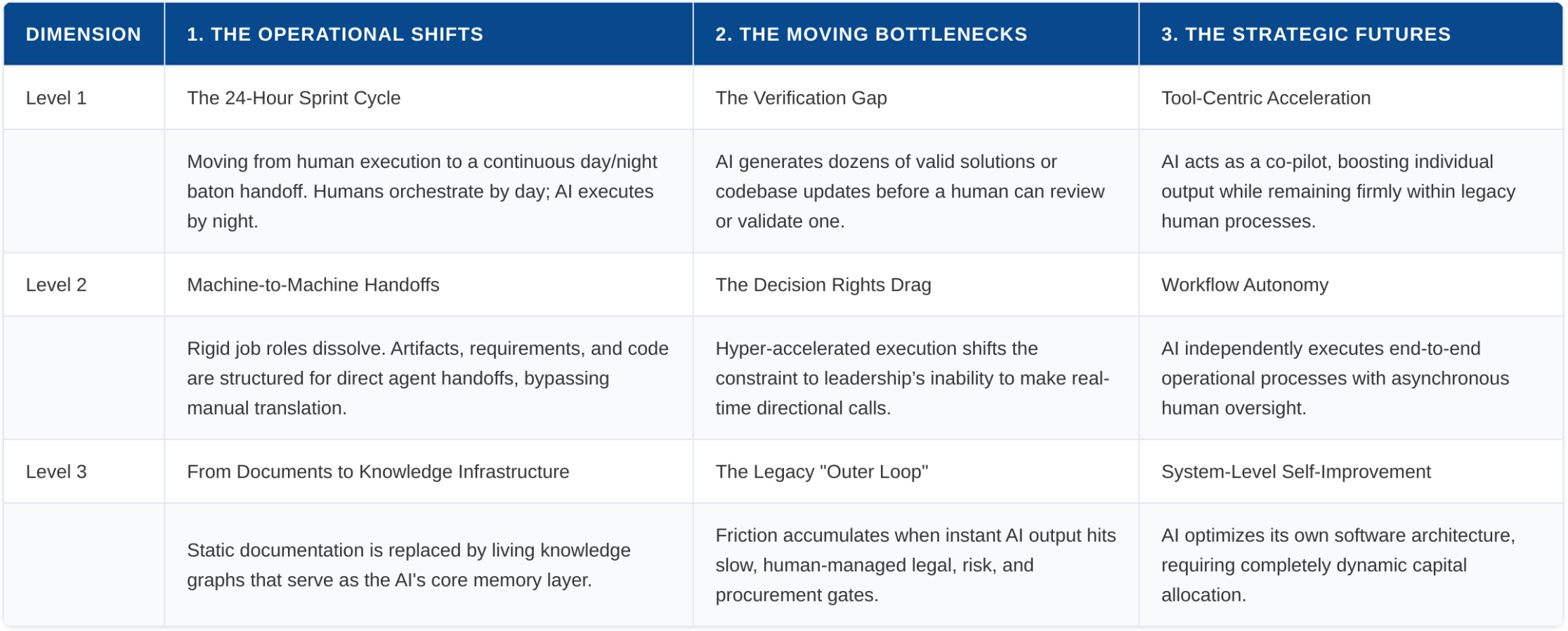
The 3×3 Agentic Transformation Matrix
When advising my clients, I map this paradigm shift across three core dimensions: Shifts, Bottlenecks, and Strategic Scenarios.
Engineering Governance Into the Pipeline
As McKinsey notes, a faster operational loop means nothing if compliance and risk processes remain siloed gatekeepers at the end of the line. When execution velocity approaches near instant, modern governance becomes your primary competitive advantage.
To avoid a systemic freeze, enterprise leaders must build immediate capabilities in four areas:
- Policy as Code: Baking compliance, guardrails, and automated escalation thresholds directly into the AI pipeline by design.
- Knowledge Architecture: Treating domain-specific data and organizational context as vital production infrastructure to fuel agent autonomy.
- Independent Internal Verification: Dedicated, cross-functional review pods engineered explicitly to validate AI-generated outcomes.
- External Stakeholder Coordination: Aligning fluid, automated workflows with regulators, insurers, and auditors.
What Organizations Must Do Now
Waiting for recursive self-improvement to fully mature risks total disruption. The groundwork must be laid today through five immediate actions:
- Redesign for Continuous Throughput: Transition key operational teams from standard cycles (e.g., 2-week sprints) to continuous, human-in-the-loop day/night execution. By not redesigning when and how humans hand off to agents, organizations might leave 13 nights of agent capacity unused.
- Automate Human Handoffs: Codify requirements, architecture specifications, and user stories into standardized, machine-readable formats so agents can execute end-to-end without human intermediaries at every transition. Without this, each document may live across disconnected systems and tools, and each transition introduces ambiguity as humans repeatedly translate intent from one artifact to another. Making it catastrophic when agent pipelines are running overnight and a single ambiguous handoff stalls the entire cycle.
- Build Your Memory Layer: Don’t wait for a top-down data overhaul. Start building organic knowledge graphs around your highest-value priority domains. Agents without institutional memory make confident, wrong decisions at machine speed.
- Resize and Reskill Pods: Shift engineering and business roles away from manual coordination toward architectural coherence, domain modeling, and AI supervision. In short, the human skill premium is migrating rapidly from execution to judgment.
- Reallocate Capacity Intentionally: Reinvest freed capacity from efficiency gains directly into accelerating your strategic roadmap. And make that reallocation decision before the productivity gains arrive, not after. Freed capacity without intentional redeployment does not create competitive advantage; it creates organizational noise.
The Closing View
We are moving past the era of the AI technology shift and entering the era of the operating model transformation. When machines can execute and optimize faster than organizations can structure tasks, leadership (not technology) becomes the ultimate constraint.
The enterprises that thrive tomorrow will be those that aggressively rewired how they operate today.
💬Here’s the uncomfortable question I’m asking every client: If your AI pipeline ran 24 hours today, which human in your organization would be the first bottleneck? And do they know it yet?
#AgenticAI #AIGovernance #EnterpriseAI #AILeadership #GenerativeAI #FutureOfWork #TechStrategy #CXO