
The Agentic Landscape Archetypes
The primary source of competitive advantage is shifting from the intelligence layer (the “brain”) to the execution layer (the “claw”). Hence, the current challenge is determining which agentic architecture aligns with your organization’s security, scalability, use cases and operational requirements.
Today’s “Agentic Stack” is fragmenting into four distinct architectural archetypes, each representing a different philosophy of autonomy and risk.
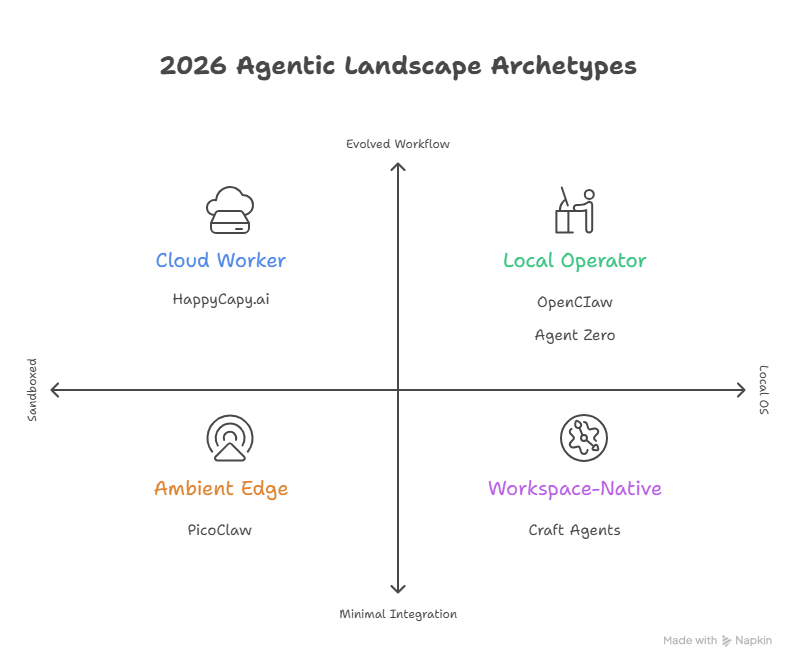
1. The Local Operator (Edge-to-Action)
These systems treat the agent as a direct extension of the user’s identity. They operate within the user’s local environment (OS-level access), possessing the authority to click, type, and navigate workflows in real-time. They are designed for deep integration with the user’s local environment.
- OpenClaw: The current standard for the “messaging-to-machine” bridge. It treats your messaging app (Telegram, WhatsApp) as a remote terminal to your local OS, enabling file manipulation, browser control, and shell execution.
- Agent Zero: A framework built for high-autonomy local execution. It leverages Docker to sandbox code generation, allowing the agent to “learn” by writing its own tools and executing them in a controlled local environment.
- Strategic Profile: High capability, high risk. These are preferred by developers and power users who require “heavy lifting” across local files and system processes.
- Value: High individual productivity and deep automation.
2. The Ambient Edge (Minimized Footprint)
Edge Agents focus on a minimal footprint. They are designed to run on-device (e.g., mobile phones) or on lightweight hardware (incl. Raspberry Pi), utilizing cloud-assisted reasoning only when necessary. Their focus is radical efficiency and minimal resource consumption.
- Nanobot: Built with a “minimalist-first” philosophy (~4,000 lines of Python). It provides core agency (web search, memory, scheduling) while being 99% smaller than enterprise stacks. (Note: Stripped down and highly optimized version of OpenClaw)
- PicoClaw: A Go-native refactor of the agentic loop designed to run on $10 hardware (like RISC-V or ARM) with <10MB of RAM. It represents the “agent as a utility” vision.
- Strategic Profile: They shift agency from centralized compute to distributed presence. Cheap, ubiquitous, and deployable on the edge where cloud-heavy agents are too expensive or slow.
- Value: Scalability and cost-efficiency.
3. The Cloud-Sandboxed Worker (Managed Autonomy)
This architecture provides the agent with its own isolated compute environment. In short, a “virtual computer” for the AI. This is not just safer but also governable. This category prioritizes safety and “always-on” reliability by decoupling the agent from the user’s physical hardware.
- HappyCapy.ai: A browser-based “agent computer.” It provides a persistent, visual cloud desktop where agents (like Claude Code) execute tasks in a secure sandbox. You can literally watch the agent work via a GUI.
- Strategic Profile: This is the enterprise “sweet spot.” It allows for auditability and remote execution without giving an AI agent direct access to an employee’s laptop.
- Value: Security and Auditability.
4. The Workspace-Native Collaborator (Contextual Agency)
Instead of a separate bot, these tools embed agency into the existing knowledge environment. The workspace itself becomes “agent-aware.” This reshapes the “Human-in-the-Loop” (HITL) model, turning documents from static records into executable workflows. Several tools fall in this category. E.g., Notion AI, Cursor, Figma Make.
- Craft Agents: A document-centric approach that turns workspaces into “agent-aware” environments. It focuses on multitasking and connecting disparate APIs (Slack, Gmail, Linear) directly into a beautiful, non-CLI interface.
- Strategic Profile: This is the “Knowledge Worker” play. The agent is a teammate that lives inside your project management or documentation tool, rather than an external operator.
- Value: Contextual Intelligence.
The Decision Framework
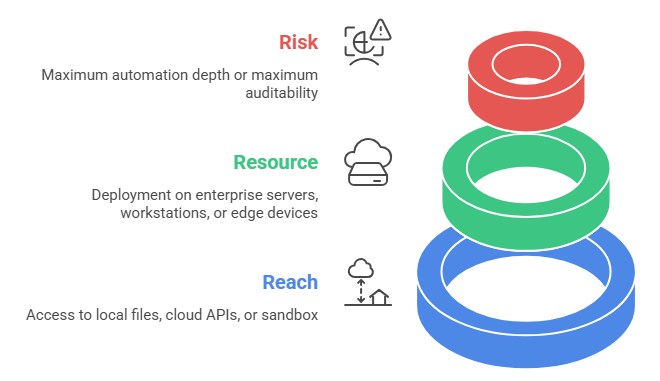
When evaluating these tools for your organization, the model (Claude Opus 4.6, Codex 5.3, Kimi K2.5 etc.) is the least interesting variable. Instead, use the following “Three-R” Lens:
- Reach: Does the agent need to touch local files (OpenClaw), cloud APIs (Craft Agents), or stay in a sandbox (HappyCapy)?
- Resource: Are you deploying on enterprise servers, local workstations, or low-cost edge devices (PicoClaw)?
- Risk: Is the goal maximum automation depth (Local Operators) or maximum auditability (Cloud Workers)?
The winner in your stack is not the “smartest” agent, but the one whose runtime fits most seamlessly into your use case, existing security and infrastructure protocols. Remember, we are moving from “Apps as Interfaces” to “Agents as Interfaces.”
Runtime interoperability beats model superiority!
#AIAgents #EnterpriseAI #DigitalTransformation #CIO #FutureOfWork #AIArchitecture #AgenticWorkflows