
Google’s Universal Commerce Protocol (UCP) Demystified
A Strategic Lens for Retail Executives
The race to define how AI agents shop is on. On January 11, 2026, at the NRF Retail’s Big Show in New York, Google launched the Universal Commerce Protocol (UCP), an open specification designed to become the common language between AI assistants and retail platforms to navigate the entire shopping journey. This is co-developed with heavyweights like Shopify, Etsy, Wayfair, Target, and Walmart, and endorsed by over 20 ecosystem players including Adyen, American Express, Mastercard, Stripe, and Visa to shape the future of AI-mediated commerce.
For Retail executives, this is a potential inflection point in how commerce is discovered and transacted in an agentic world. AI agents are projected to influence up to $3-5 trillion in global retail spend by 2030, according to McKinsey estimates. Here’s my analysis to help you evaluate UCPs fit for your business, grounded in verifiable facts as of January 2026.
Let me cut through the jargons first. To grasp UCP’s role, think of AI commerce as a layered architecture. Each protocol addresses a distinct need, and UCP is a commerce-specific layer built “on top” of MCP and Agent2Agent (A2A) as a commerce‑specific standard, not a replacement. Here’s how they differ technically and strategically:
- MCP (Model Context Protocol): It’s a general-purpose protocol (championed by Anthropic and others) that allows AI models to securely access tools, data, and context. It’s not commerce-specific. [LinkedIn]
- Agent2Agent (A2A): This is the messaging system for AI agents. It enables agents from different platforms to discover, delegate tasks, and coordinate with each other securely. It handles the “conversation” between agents, not the commerce transaction details. [Cobus Greyling]
- Universal Commerce Protocol (UCP): This is a commerce-domain protocol. It standardizes the key entities and flows of retail: product discovery, cart management, checkout, order tracking, and returns. It uses MCP for data access and can leverage A2A for agent coordination, AP2 for payments, etc. but its sole focus is standardizing the commercial transaction layer. [Google Cloud].
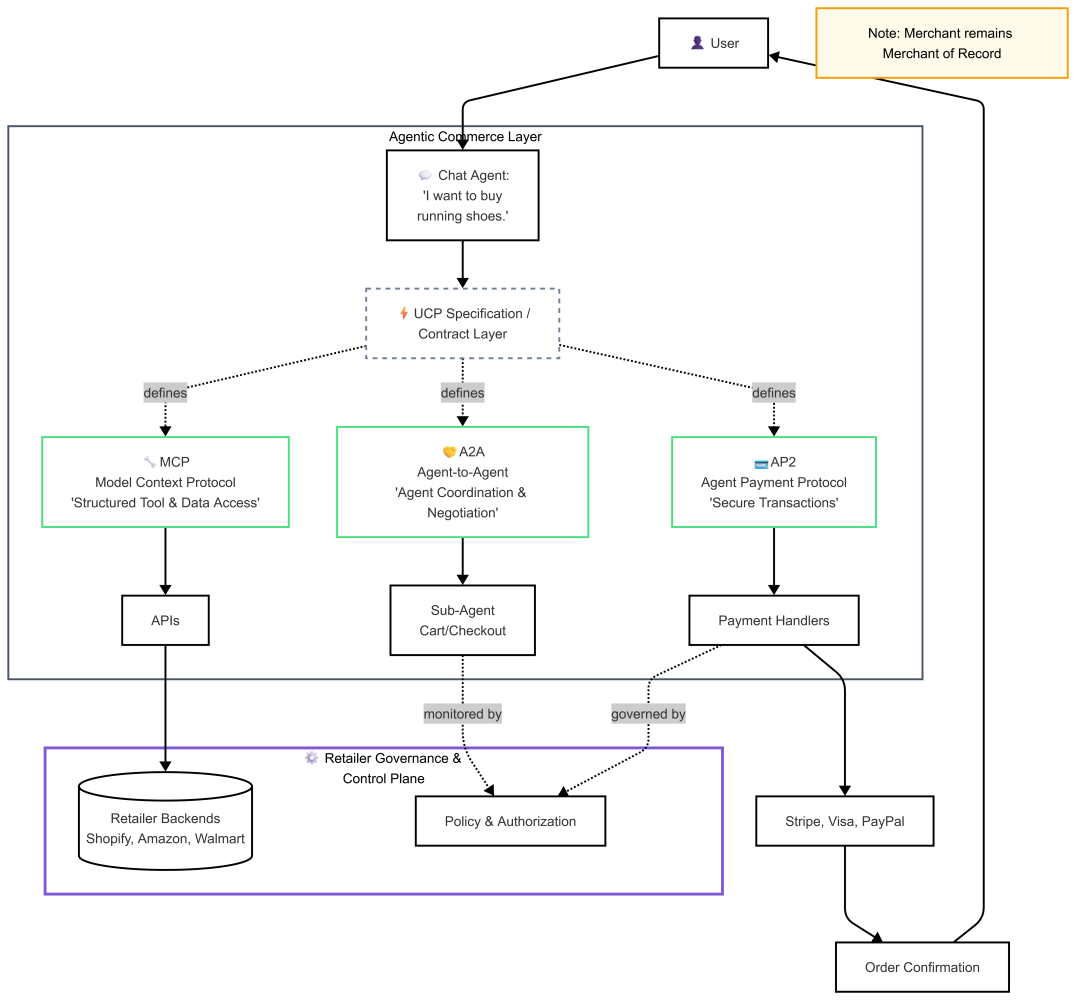
In summary, UCP doesn’t replace MCP or A2A; it leverages them. For instance, MCP handles data access for product catalogs, A2A coordinates agents (e.g., a user’s Gemini agent delegating to a retailer’s inventory agent), and UCP standardizes the transaction semantics. This modularity avoids silos or in other words, democratizes AI commerce. Of course, it means UCP’s success hinges on ecosystem adoption, but early signs are promising with partners like Salesforce announcing support for agentic flows.
Protocols don’t just standardize technology. They standardize power.”
The Competitive ‘moat’: Why This Matters
Without standards, retailers face an “N-to-N” integration nightmare: custom APIs for every AI platform (Gemini, ChatGPT, Perplexity). UCP flips that to “1-to-N”, potentially slashing development costs by 50-70% for multi-agent setups, based on similar protocol adoptions like MCP. Gartner forecasts 40% of enterprise apps featuring task-specific AI agents by end-2026, up from <5% in 2025.
- For Google: This is an ecosystem play. By openly publishing UCP, Google aims to establish it as the default “grammar” for AI commerce. If widely adopted, it ensures that Google’s surfaces, from Gemini to Search Generative Experience, can seamlessly transact with any compliant retailer. The goal is to become the indispensable orchestration layer, anchoring merchants within its ecosystem.
- For AI Players (Anthropic, OpenAI, etc.): They now face a choice. They can either integrate UCP support to give their agents native commerce capability, or they must build/back an alternative standard. Without a standard like UCP, each AI assistant would need to negotiate custom, brittle integrations with every retailer, which would be a untenable scaling problem.
- For Retailers & CPG Brands: The Upside (Efficiency & Control) – a single, standardized integration could make your catalog and checkout discoverable by a multitude of AI agents across different platforms (Google, OpenAI, Shopify, CoPilot, etc.). This is far more efficient than building custom connections for each. It also promises to preserve your status as the Merchant of Record, maintaining control over pricing, promotions, fulfillment, and “critically” the direct customer relationship and data.
- The Risk (Strategic Leverage): Ceding the definition of the commerce “interface” to Google and a consortium of large tech players could subtly shift leverage over time. Questions arise: How are products ranked in AI-driven discovery? What are the default choices presented to the consumer? Could future fees or requirements be introduced? The protocol may be open, but its evolution and the governance of its implementation will be a key battleground.
- Customer Experience Impact: Agents promise frictionless shopping. But it fragments journeys: 53% of U.S. consumers used gen AI for shopping in Q2 2025, yet trust issues persist around data privacy and bias. Future-proofing requires auditing how agents represent your brand monthly, as 83% of CPG leaders now do.
The core dilemma: Engage early for first-mover gains, or wait and risk irrelevance as agents redirect trillions in spend?
Practical Considerations: The Implementation Reality
Jumping on the UCP train is not a light undertaking. Google’s own documentation frames it as a focused but non-trivial API project. Leaders should gauge effort against these realities:
- Core Lift: Implementation revolves around 3-5 core endpoints (Product, Cart, Checkout, Order, Returns) plus OAuth for security. This requires dedicated API platform resources.
- Data Rigor: UCP demands high-quality, structured, and real-time data feeds for inventory, pricing, and promotions. Inconsistent data will break the AI agent trust.
- Extension Points: The base protocol will need extensions for your unique business logic (complex promotions, bundled items, specific delivery options). This is where differentiation happens.
- Effort and Timeline: For a mid-sized retailer, expect 4-6 months and 3-5 full-time engineers for initial integration, assuming robust APIs exist. Total investment: $500K-$2M upfront, per industry benchmarks for similar protocols.
- Ongoing Governance: You’ll need a team to manage the integration, ensure compliance with protocol updates, and monitor the quality of AI-driven traffic and conversions.
Bad data doesn’t degrade agentic commerce—it disqualifies you from it.
The Bottom Line for Leaders: Act or Observe?
UCP represents a bet on a standardized, AI-native future for commerce. It fits into 2026 trends like model specialization and regulation, where AI spending surges but readiness gaps persist. For your business, it’s strategic if API foundations are solid and AI volume justifies the lift.
Plan to hop on the UCP train?
- Start with an Agentic Commerce Readiness audit: What’s our data rigor? How do we monitor AI traffic quality? Can we opt-in selectively for UCP features? Do your systems support streaming? Can teams handle change management? Build a gap map tied to UCP object requirements.
- Quantify Economic Stake: Compute expected volume and agent-driven commerce value using your existing traffic and conversion data in your 3-year horizon. E.g., What % of “top-of-funnel” traffic is already AI-driven?
- Assess your API maturity: A robust, composable commerce architecture is the prerequisite.
- Engage in the conversation: Monitor closely the adoption by other major platforms and your key competitors.
Is your organization evaluating UCP or similar agentic commerce standards? What are your primary concerns? Reach out to me and we can have a deep-dive on the right-fit path for your organization.
References & Sources
- https://nrf.com/blog/google-deepens-ai-investments-that-impact-retail
- https://ucp.dev/
- https://blog.lengow.com/googles-universal-commerce-protocol-the-end-of-e-commerce-as-we-know-it/
- https://www.thesling.org/the-harm-to-consumers-and-sellers-from-universal-commerce-protocol-in-googles-own-words/
- https://www.youtube.com/watch?v=ZeoV3Nu1Czk
#AICommerce #RetailStrategy #AgenticAI #RetailTechnology #DigitalCommerce #RetailLeadership #FutureOfRetail #UCP #DigitalTransformation #Google