The Demo Dazzled the Board. The P&L Never Noticed.
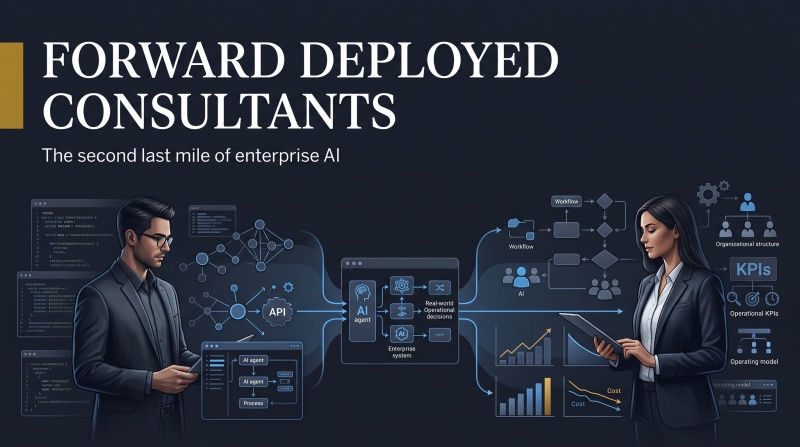
Enterprise AI has an absorption problem. It needs Forward Deployed Consultants working alongside Forward Deployed Engineers.
The board saw the future. Nine months later, what had changed?
The agent took less than a minute.
On the boardroom screen, it absorbed a stream of network alarms, separated the probable root cause from the noise, triaged the affected tickets, and drafted a remediation plan. It even anticipated which customers were likely to call before they picked up the phone. The demonstration was fast, fluent, and almost unnervingly competent.
The board leaned forward. The chief executive smiled. Someone asked how quickly it could scale.
Nine months later, the same chief executive asked a simpler question: “What changed?”
Silence.
The model was live. Accuracy was excellent. Uptime was five-nines. The engineering was superb. Yet frontline teams still followed the old escalation paths, managers reviewed the same reports, legacy tools remained licensed, and decision rights remained ambiguous. Costs had not moved.
The P&L could not tell that the future had arrived.
I see and hear versions of this pattern every day: an enterprise solves the technically difficult problem, declares victory at go-live, and then discovers that the organization has not changed with the technology. In AI, models can move from impressive to production-ready faster than most enterprises can redesign work, trust, incentives, governance, and accountability around them.
In short, we have become remarkably good at making the technology work. But remain far less disciplined about what happens after it works.
The missing role is the Forward Deployed Consultant (FDC). A practitioner embedded close to the code and inside the business system that must absorb it.
The engineer who changed enterprise software
The Forward Deployed Engineer (FDE) changed the way complex enterprise software is brought to life.
Palantir Technologies popularized the role: an engineer who embeds directly with a client team, attends its stand-ups, works in its environment, commits to its repositories, and owns technical decisions end-to-end until software runs in production. This was more than premium implementation support. It collapsed the distance between product, engineering, and the operational problem.
Traditional enterprise software left a dangerous gap between the signed contract and working code. Vendors sold the capability, integrators translated requirements, and client teams inherited the complexity. Handoffs multiplied while accountability blurred.
The FDE closed that technical last mile: solving integration problems in the field, coding through edge cases, and shipping software that survived contact with real data, infrastructure, and users.
FDE closes the product-to-production feedback loop. FDC closes the production-to-operating-model feedback loop.
That model is now going mainstream. Every GSI is scrambling to train and recruit FDEs at scale for enterprise AI programs. The reason is obvious: in AI, the distance from prototype to production is littered with data-quality failures, architectural trade-offs, model-risk decisions, lack of evals, governance, and legacy-system constraints.
The FDE is essential. But production is not the finish line, executives think it is.
The second last mile
There is another last mile, and it begins precisely where the first one ends.
Call it the organizational last mile: the distance between “the model is in production” and “the business now runs differently.” It includes the work nobody sees in the demo like rewriting decision rights, retiring old processes (and communicating them), changing performance measures, embedding human in the loop, enabling a trust framework, resolving cross-functional conflicts, and making leaders accountable for absorption rather than installation.
In almost every case, nobody owns this distance today.
The FDE’s mandate centers on working software. The integrator’s mandate ends at stabilization. The transformation office tracks milestones. The business signs off on requirements describing its current process and forgets the new operating model that must take effect.
The result is not always outright failure. As the system works, some people use it, dashboards show activity, and the economics barely move. AI becomes an additional layer of cost and complexity instead of a mechanism for removing both.
This is the second last mile. Where technical success becomes organizational ambiguity and the Forward Deployed Consultant (FDC) earns the name.
FDE vs. FDC: a field guide
An FDC is neither an FDE with softer skills, nor a traditional change manager assigned after deployment. The two roles are complementary because they attack different constraints.
FDC is a person accountable for changing the decision system around an AI capability.
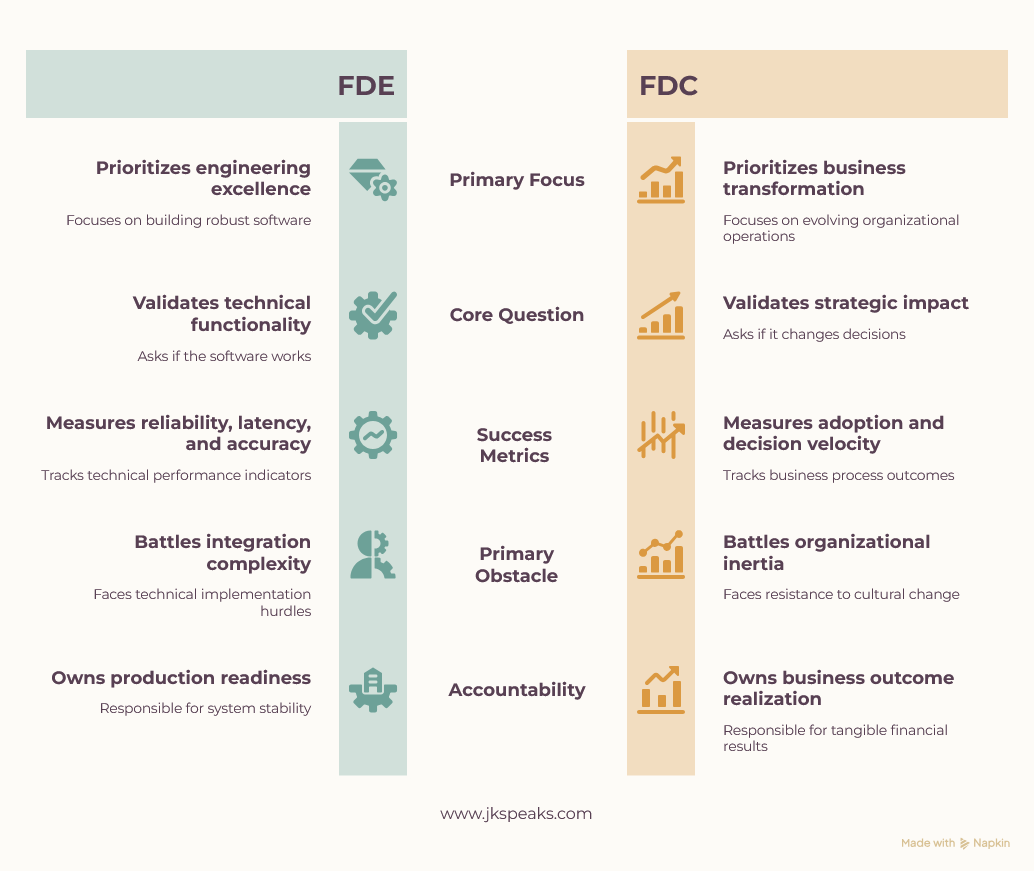
Both roles are builders. They simply build different halves of the outcome.
Why they must coexist
Technology without transformation becomes shelfware. Transformation without technology becomes slideware. Enterprises have spent decades buying one and commissioning the other as separate workstreams, then wondering why the value case dissolves between them.
The evidence: Even Palantir (the company that created the FDE model) pairs its engineers with Deployment Strategists. Those strategists work with customer teams to understand critical questions and workflows, build solutions for new user groups, lead training, and ensure the product is used widely enough to create operational impact.
This is an acknowledgment that engineering alone does not land the outcome. If the birthplace of the FDE concluded that technical capability needs a field-deployed counterpart focused on operational priorities and absorption, every enterprise AI leader should pay attention.
The logic can be expressed in one line:
AI Value = Capability × Absorption × Economics
FDEs maximize capability. FDCs maximize absorption and economic impact. This could be through communications & training, redesign of work, incentives, governance, and decisions. Because the relationship is multiplicative, a zero on either side zeroes the equation. In addition, unabsorbed AI creates 100% waste.
Adoption is a behavior. Absorption is an operating-model change.
A brilliant model that nobody trusts produces no value. Hence, the winning unit is not the FDE or the FDC. But the pair: two forms of forward deployment, sharing one business outcome.
Scenario A: A telecom operator whose agents worked at cross-purposes
Consider an anonymized composite drawn from patterns now appearing across telcos.
A Tier-1 operator with millions of subscribers goes big on agentic AI. It deploys agents across network operations and customer care. The engineering is excellent: one agent predicts faults, another triages tickets, another recommends capacity changes, and a care agent proposes next-best actions for customers at risk of leaving.
Then the system meets the enterprise.
The network agent throttles capacity in one domain to contain cost. At the same moment, the care agent promises premium speeds to recover a detractor. Each agent optimizes its assigned objective. Together, they create an incoherent customer and operating outcome.
As enterprises move from AI assistants to AI agents, the unit of transformation shifts from the individual workflow to the interaction between workflows.
Network-operations veterans, trained on deterministic systems, do not trust autonomous actions they cannot reconstruct. They keep manual overrides. Legacy assurance processes remain “for safety,” existing tools are not retired, and AI costs stack on top of the old cost base.
Governance exists, but as a slide deck reviewed quarterly instead of a control system operating in real time.
The CTO’s dashboard glowed green. The CFO’s opex line climbed.
Bain & Company has warned telecom leaders about these traps: bolting AI onto legacy processes, mistaking demonstrations for transformation, and scaling new expenses without retiring legacy processes, tooling, and structures. An Amdocs executive put the orchestration problem even more directly: “Everyone is talking about building agents. Not enough people are talking about controlling them.” Gartner predicts that by 2027, 40% of enterprises will demote or decommission autonomous AI agents due to governance gaps identified only after production incidents occur.
None of those warnings is about model accuracy.
The FDC treats the operator as one decision system. Cross-domain objectives are reconciled through agent orchestration and real-time governance. Legacy assurance steps are retired, network roles shift from ticket triage to exception management, and escalation protocols assign accountability when agents disagree or cross a threshold.
Most importantly, autonomy advances through a trust ladder: assist → advise → act (within guardrails) → Autonomous.
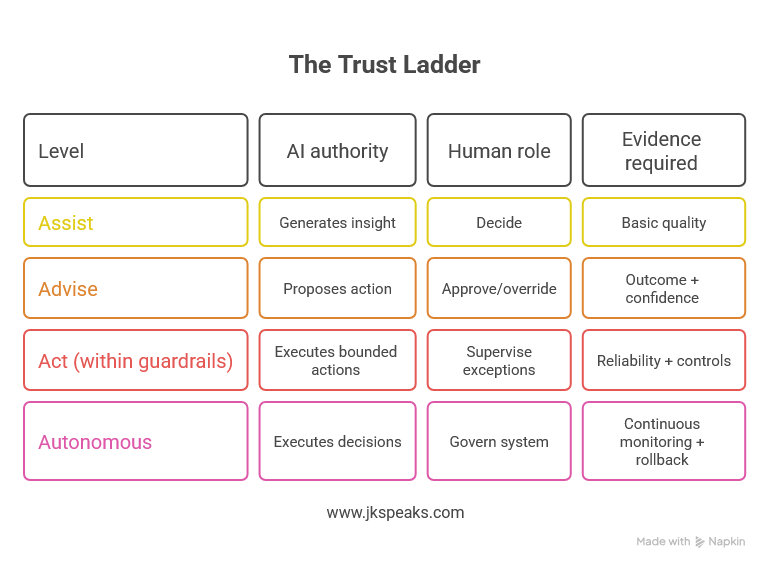
Operators see evidence, challenge decisions, and earn confidence before control expands.
Same models. Same agents. Different business around them. That is when the cost curve finally bends.
Scenario B: The retailer whose forecast nobody believed
Now consider a retailer with thousands of stores and billions tied up in inventory.
The company deploys AI demand forecasting and automated replenishment. The FDE team connects point-of-sale data, promotions, digital behavior, supplier lead times, and local patterns. The platform performs reliably. Forecast accuracy improves. Recommendations arrive faster and at a granularity planners could never match manually.
Yet the users keep overriding it.
The model is perceived as a black box, while the users’ reputations (and often their incentives) still reward the instinctive calls they make themselves. Accepting the forecast can feel like surrendering their craft and status. Overriding it carries little consequence, even when the evidence is thin.
Meanwhile, planning remains fragmented across merchandising, supply chain, and stores. A 2024 RELEX study has found that roughly a third of retail and consumer-product leaders say disconnected planning across teams, systems, and regions disrupts end-to-end synchronization. Inside this retailer, the replenishment engine issues the right order, but the old approval chain delays it for days. Marketing launches calendar-driven campaigns while the personalization engine starves for timely signals. Store managers build local buffers because they do not trust central availability.
The forecast was right. The organization was stuck with legacy ways of working.
The FDC does not respond with another training session. The intervention changes the system around the forecast.
First comes an explainability layer that exposes the major demand signals and assumptions behind a recommendation. Transparency is not cosmetic; it gives planners a reason to trust, question, and improve the output. Second comes an override protocol: who may override the model, under what conditions, with what evidence, and how the outcome will be reviewed.
Overrides become data, not defiance.
The planning silos collapse into one integrated cadence with shared assumptions and a single set of trade-offs. Users’ incentives shift toward forecast adherence, sell-through, and the quality of documented exceptions instead of the volume of personal interventions. Planners are retrained from spreadsheet operators to exception managers who focus on events the model cannot reasonably anticipate.
If the organization rewards planners for being right rather than for making the best decision with the model, model adoption will remain irrational.
Only then does improved forecast accuracy translate into what the CFO actually cares about: healthier inventory turns and stronger margin.
What the FDC actually does
A Forward Deployed Consultant lives where strategy, operations, technology, and human behavior collide. The role is defined by three integrations:
- Workflow integration: redesign the work around the machine. Every AI capability implies a new division of labor between human and machine. Which decisions should the AI prepare? Which can it make? Which require human judgment? What happens when confidence is low or objectives conflict? If these choices are not made deliberately, the old workflow quietly reasserts itself. The FDC redesigns the end-to-end flow, removes obsolete work, and makes exceptions more important than routine.
- Incentive integration: make it rational to let the machine decide. People rarely resist AI because they are Luddites. They resist when compensation, authority, professional identity, or perceived safety remains tied to the old way. Asking a user to trust a forecast while rewarding personal overrides is contradiction. The FDC aligns measures, roles, and consequences so adopting the new decision model becomes rational.
- Governance integration: build trust as an operating mechanism. Governance cannot be a policy binder that appears after an incident. The FDC establishes clear accountability, live controls, escalation paths, and a staged trust ladder from “AI assists” to “AI recommends” to “AI acts within guardrails.” Autonomy expands when evidence supports it.
For every AI initiative, the FDC should establish a chain like:
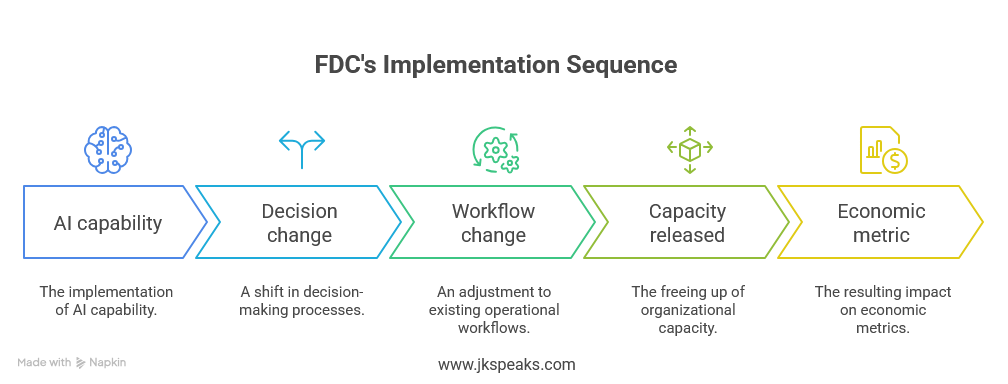
For example, in Scenario B:
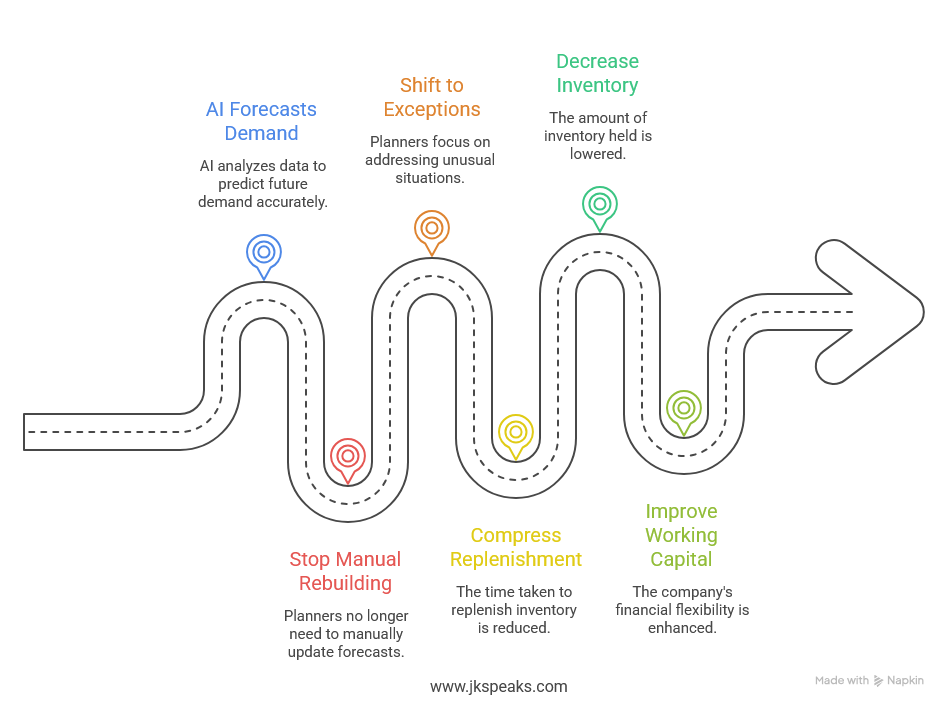
That’s the bridge between AI deployment and P&L impact.
How to deploy the pair
Stop organizing technical delivery and business absorption as sequential tracks.
- Deploy them as one pod, not two vendors. The FDE and FDC need a shared backlog, shared stand-up, shared executive sponsor, and a definition of done that ends at business outcomes as against a production release.
- Send the FDC with the FDE. Workflow, incentives, controls, and decision rights shape technical requirements. Treating absorption as a downstream activity forces the team to retrofit the organization around decisions already baked into the system. By then, every change is harder and more expensive.
- Govern capability and absorption on the same page. Put reliability, latency, accuracy, and model risk beside absorption, override behavior, decision speed, process retirement, and business impact. A green engineering dashboard cannot compensate for a red operating model.
- Measure what matters after novelty fades. Go-live dates and model accuracy are milestones. Track whether people use the capability, whether decisions happen faster and better, whether legacy work disappears, and whether margin or cost impact is sustained.
The pod should not ask, “Did we deploy the AI?” It should ask, “What is now measurably different because we did?”
The next phase of enterprise AI
Return to the chief executive in the boardroom nine months later.
The question is now different, as AI did work. The engineers had solved the problem they were asked to solve. The unresolved question is whether the organization could absorb what they had built. i.e., whether workflows, incentives, governance, and accountability would move with the technology.
The next bottleneck in enterprise AI will be whether companies can redesign their organization fast enough to let those AI systems matter.
Models are rapidly becoming more capable, more accessible, and more interchangeable. So, sustainable advantage will come from the speed and discipline with which an enterprise can convert capability into a different way of operating. And keep that change alive after the implementation team leaves.
The competitive advantage will belong to the enterprise that can absorb new AI fastest.
That requires two kinds of forward-deployed talent: the engineers who make AI work in the reality of the enterprise, and the consultants who make the enterprise work with AI.
One ships the capability. The other ships the transformation. You need both. And need them at the same time.
Source:
- https://www.gartner.com/en/articles/cio-planning-for-2027
- https://www.gartner.com/en/newsroom/press-releases/2026-05-26-gartner-says-applying-uniform-governance-across-ai-agents-will-lead-to-enterprise-ai-agent-failure
- https://kbjr.marketminute.com/article/bizwire-2024-4-8-new-relex-study-reveals-ais-untapped-potential-retail-and-cpgs-yet-to-fully-embrace-technology-that-drives-demand-forecasting-accuracy
#EnterpriseAI #AgenticAI #AITransformation #AIOperatingModel #OperatingModel #ForwardDeployed #DigitalTransformation #AILeadership