Codeburn: For cost visibility
🚨AI developers or engineering team leaders, you need to look at this.🚨
Over the last few months, my usage of #Claude has skyrocketed. As someone who spent years in the BI space, I have a natural itch to analyze patterns. Yet, I found myself hitting a wall with a fundamental question: Where exactly are my tokens getting spent?
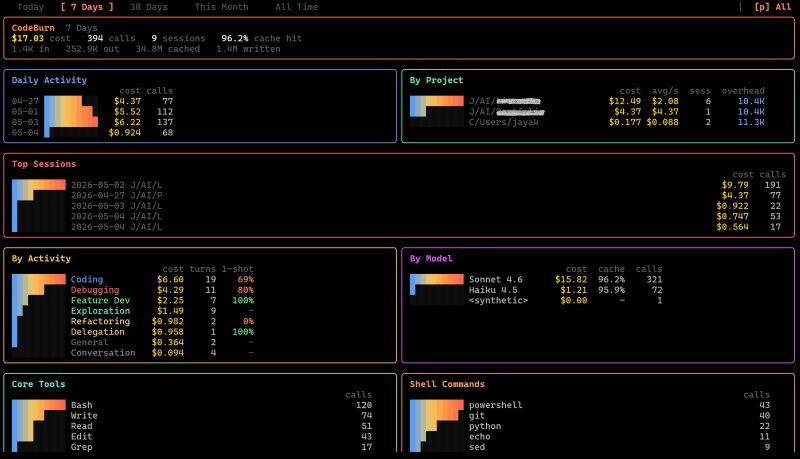
I recently tested an open-source tool called Codeburn ✨, and the “magic” is in its simplicity. You can just run “npx codeburn” on your PowerShell, and you can see this in action (no persistence).
While many of us are heavy users of Claude, our professional workflows are increasingly hybrid, spanning tools like Cursor, Codex, etc. Codeburn provides a unified, local TUI dashboard that parses your session data directly. Because it operates locally, there are no API keys to manage and no SaaS privacy concerns. Just raw, actionable observability!
In under a minute, I had visibility into:
• Which models I’m actually using (vs. thinking I’m using)
• Where my token spend clusters are (by request type, by tool, by time)
• The silent killers, whose “quick” tasks were quietly driving up costs
• Concrete optimizations levers to test
For consultants and practitioners piloting AI agents, this level of visibility is table-stakes. We often say you can’t analyze or improve what you can’t measure; in the world of agentic workflows, this is critical.
🚀I strongly recommend that developers use this for their individual cost visibility during the experimentation/development phase. The dashboard does the storytelling for you.
👉Git Repo: https://github.com/getagentseal/codeburn
If you have used other tools like codeburn, please share in the comments.
DataDriven #TokenEconomics #AIEngineering #LLMObservability #DeveloperTools #AgenticAI #SixSigma #DMAIC