
The Blueprint for Enterprise Agentic AI
If you’ve been tracking the search trends for OpenClaw lately, you aren’t just looking at a graph; you’re looking at the heartbeat of the next industrial (AI) shift.
OpenClaw is emerging at a moment when organizations are no longer constrained by access to intelligence, but by the speed of execution across fragmented systems. The bottleneck has shifted from “thinking” to “doing.”
In the last 60 days, we’ve witnessed a classic Innovation Trigger move toward a Peak of Inflated Expectations, followed by a swift (and necessary) Trough of Disillusionment. But for those of us watching the “Slope of Enlightenment,” the real work is just beginning.
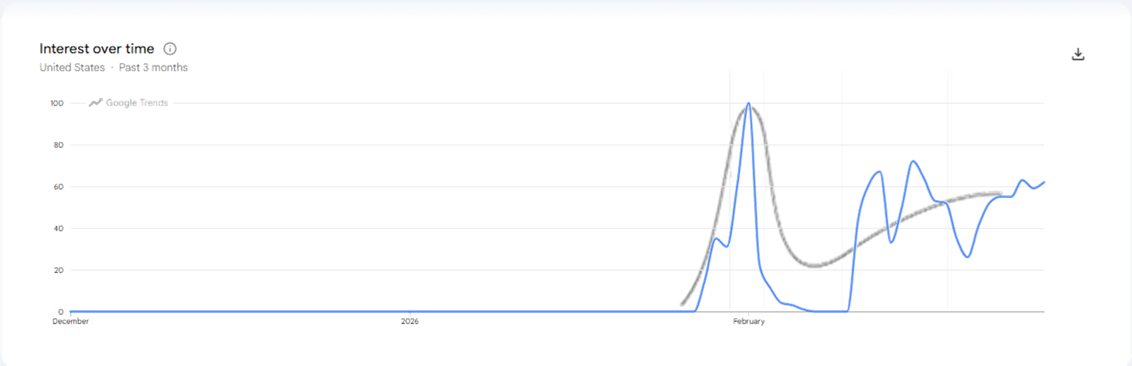
The Anatomy of the Spike: Clawdbot, Moltbot, and the Friction of First-Movers
The initial surge wasn’t just about code; it was about the promise of 24/7 autonomous agency. When Clawdbot first broke cover, it promised something we hadn’t seen: agents that didn’t just “chat,” but “did.”
However, the path wasn’t linear. The transition from Clawdbot to Moltbot, coupled with the inevitable “bad apples” snatching domains and creating friction for the creator, created some unnecessary noise.
The hype was high, but the infrastructure was fragile.
The Great Shakeout: Security as the Filter
As the initial “wow factor” faded, the industry hit a wall: Security.
When vulnerabilities surfaced, the “hype-riders” jumped ship. This dip in interest was the best thing that could have happened. It cleared the noise, leaving behind the serious architects and practitioners who moved into “Lab Mode.”
But the real enterprise hesitation is not whether agents can act. It’s whether their actions can be attributed, governed, and reversed.
While the public moved on to the next shiny object, the pros continued building localized execution environments (via Mac Mini stacks) to safely test how far this “Claw” could actually be beneficial.
Localized execution sandboxes are becoming the enterprise’s first agent runtime layer.
- Isolated compute
- Bounded authority
- Observable execution
Why the “Slope of Enlightenment” is Real
Confidence in this trajectory is now rooted in structural signals:
- The Rise of Nanobot: The pivot toward stripped-down versions is a direct response to enterprise security concerns. It proves the community is equally concerned.
- The “Acqui-hire” Signal: OpenAI bringing the creator of OpenClaw (Peter Steinberger) onboard is a validation moment. It’s no longer a viral, rogue project; it’s a foundational talent acquisition to drive next generation of personal agents and enterprise agents.
- The Competitor Surge: The emergence of Agent Zero, HappyCapy.ai and Perplexity Computer proves that “Computer Use” is the new interface layer. This is shaping into a category, not a one-off tool.
Checkout my earlier post on agentic archetypes here. My POV: What Happens Next?
Organizations are currently in a state of “Cautious Cognizance.”
They see the potential for a “True Agentic AI” capability that serves every persona from the entry-level employee to the external vendor/partners to their customers. But remain unclear on where and how to start, particularly given the security & privacy concerns surrounding execution layer autonomy.
Here are the three stages you can expect in the next 6-18 months:
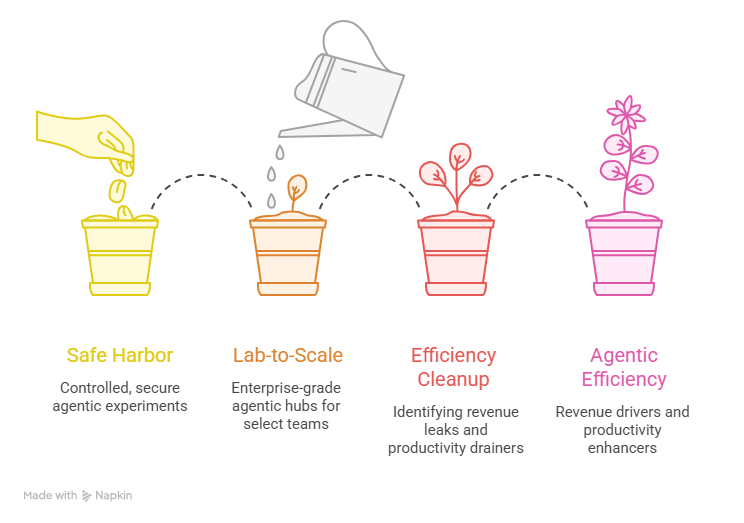
- The “Safe Harbor” Phase: Organizations will focus on bringing “The Claw” inside their firewalls via secure iterations like Nanobot and experimenting with controlled pilot team(s).
- The Lab-to-Scale Transition: Localized execution environments (using Mac Mini’s) will evolve into enterprise-grade agentic hubs, provided to select teams to run bounded, high-value agentic use cases.
- The Efficiency Cleanup: Initial deployments won’t trigger immediate layoffs, but they will act as a high-resolution X-ray for the organization. The use cases will focus on surfacing revenue leaks and internal productivity drainers leading to potential layoffs.
- Agentic Efficiency: This is when the focus will shift towards Revenue Drivers and Productivity Enhancers leading to early adopters seeing the maximum ROI.
The Bottom Line: We are moving from “AI as a tool” to “AI as a workforce” and an “AI-enabled workforce.“
Organizations that spend this quiet period to operationalize agents securely and effectively will be the ones that transition from Managing Tasks to Orchestrating Outcomes.
The hype cycle might fluctuate. But industrialization of the agent is guaranteed.
#AgenticAI #AIStrategy #DigitalTransformation #OpenClaw #ThoughtLeadership #Gartner