
Vibe Graphing will Replace Vibe Coding
The Architecture of Intent
We have all been there. Vibe coded to our hearts’ content. At least I have on a few tools like v0, lovable, mocha, bolt.new, Google AI Studio, Dyad, and Claude Code.
You write a single, “brilliant” prompt, and an LLM spits out a functional script. You feel like a wizard! But then you try to build something complex, like a multi-step workflow or a specialized agent team, and your experience can be both exhilarating & exhausting. Soon you will realize you are in a “vibe coding hell.” You spend hours re-prompting to fix structural hallucinations, logic flaws, and code that simply refuses to run.
Checkout my site Vibe2VPS if you are still trying to master vibe coding.
While vibe coding was a necessary experiment, the “Mexican standoff,” as Marc Andreessen calls it, is where every role tries to do everyone else’s job with raw prompts and is hitting a wall of “friction tax.” The industry is moving toward a more grounded, professional paradigm: Vibe Graphing.
Checkout the example in this post by Vinay S to understand the problem under the problem
The Architect vs. The Gambler
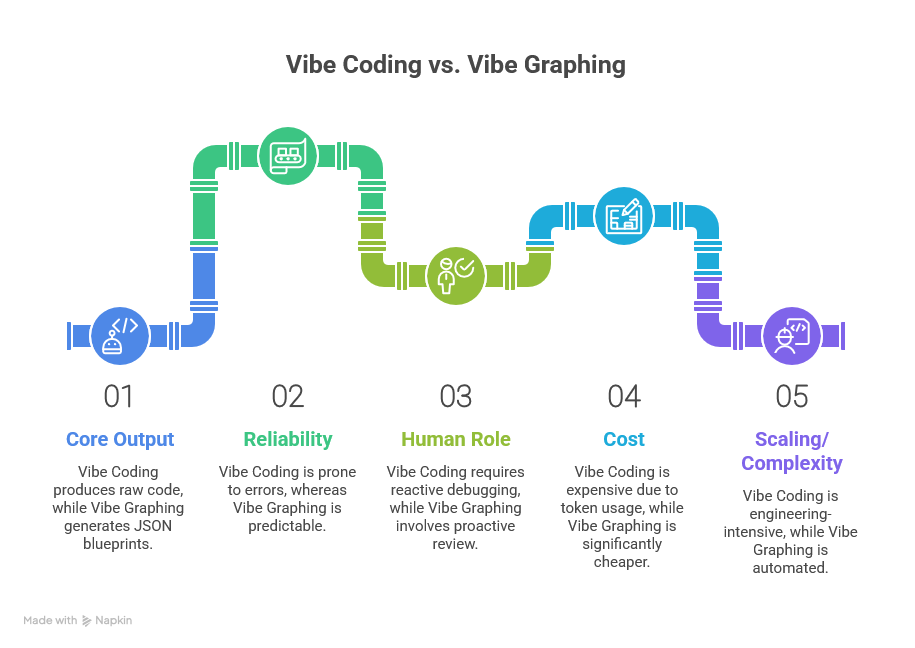
The fundamental problem with vibe coding is that it asks the AI to be the architect and the builder simultaneously, generating raw code directly from a “vibe.” In short, vibe coding is often engineering-intensive for complex systems.
Vibe Graphing flips this. It uses a high-level model to compile your intent into a structured, editable blueprint (an Intermediate Representation) before a single line of execution code is ever touched. This method also introduces a “human-in-the-loop” interaction, allowing you to review and refine the AI’s design at every stage. In summary, it shifts your (developer’s) focus from “writing code” to “AI behavioral design.”
To understand the shift, imagine you are building a custom house:
- Vibe Coding is like telling an AI, “Just build me a house,” and hoping it builds one and not a shed. If it did pick the house, it correctly placed every wire and pipe on the first try. When it puts a door in a load-bearing wall, you have to keep asking it to tear the house down and start over. This process is slow, expensive, and structurally unstable.
- Vibe Graphing is like working with an AI Architect. You tell the system your intent. The AI acts as a Project Manager, suggesting a team of specialists: an electrician, a plumber, and a lead builder. You might review this and say, “Actually, add a security specialist and an interior designer,” and the AI adjusts the team.
Why Blueprints Win
The data is hard to ignore. In case studies involving complex multi-agent systems like “ChatDev,” building the system manually required 1,511 lines of code. Using Vibe Graphing, that same system was realized with only 45 lines of instruction.

Scaling Beyond a Single Answer
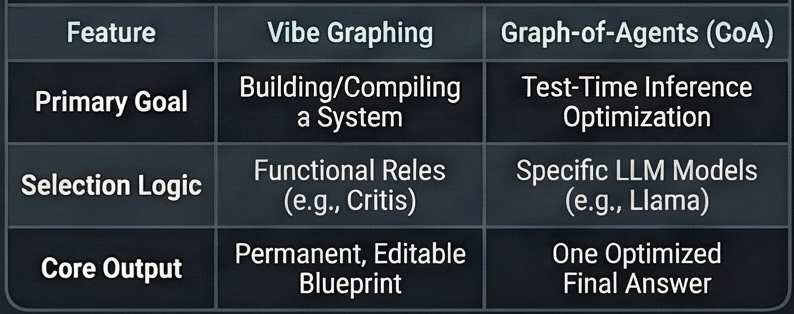
While emerging frameworks like Graph-of-Agents (GoA) focus on optimizing a single answer at runtime by orchestrating a “zoo” of LLMs, Vibe Graphing is about building the machine itself. It allows us to stop being “syntax fixers” and start being “system designers.”
By constraining AI behavior to a strict graph structure, we eliminate the noise of irrelevant agents and ensure that the “vibe” we intended is the “workflow” we actually get. Let me know in the comments if you are interested in understanding the difference between GoA and Vibe Graphing.
The experimental era of “prompt-and-pray” is closing. The era of the AI Architect or Agentic Engineer has begun.
Have you transitioned from managing extensive 1,000-line vibe coding sessions to designing your agent workflows? Share your most “expensive” vibe coding failure in the comments.
#AIAgents #VibeGraphing #VibeCoding #AgenticEngineering #AIArchitecture