
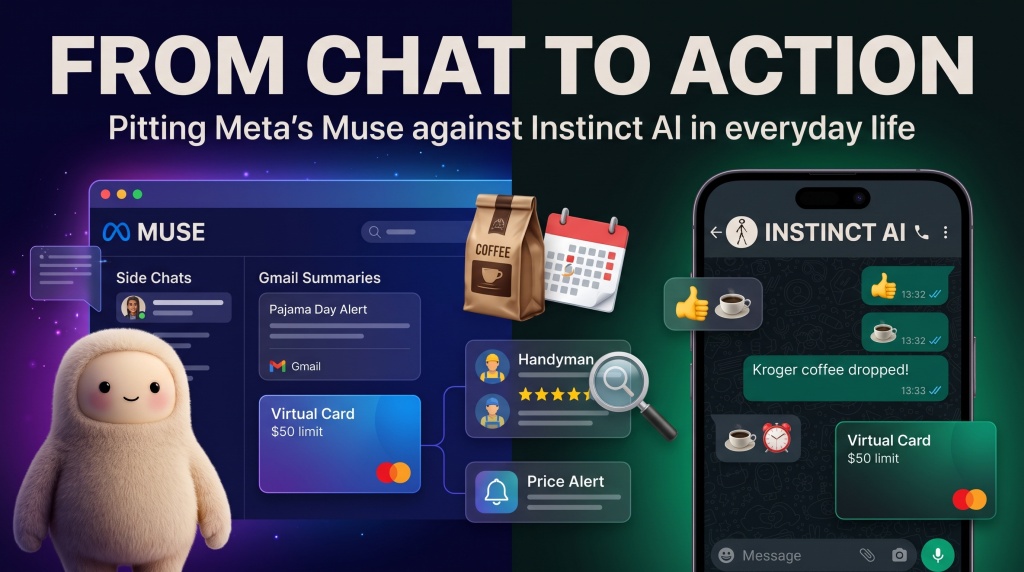
Pitting Meta’s Muse Against Instinct AI
I’ve been a bit quieter around here over the past couple of weeks, mainly because I’ve been deep in the rabbit hole with two personal AI agents: Meta’s Muse and Instinct. Both have impressed me enough that my platform loyalty is currently sitting at zero. I’m running them side by side in real-world scenarios and letting the results decide the winner.
The Muse Manifestation: What Stood Out
Early on, I was dumping everything into the main chat, and it became a scrolling nightmare. One prompt later, Muse reorganized the entire history into clean side chats that I still access every day.
When I gave it a product with some specifications, Muse was able to narrow the options down to the top four items, just like any other AI assistant. But when I gave it a specific brand and model and said I had tested it in a shop, loved it, but found it too expensive, things got interesting. Muse updated the shortlist and started tracking the product without me explicitly asking it to track it or add it to a schedule (something I had to do when Perplexity launched).
In fact, it did three things.
One, Muse provides regular updates on this product. These include price changes, offers, etc. More importantly, these notifications do not arrive at a scheduled time or on a specific day. I get them when something changes and Muse feels I should know about it. This reminds me of OpenClaw, which we saw at the start of the year. Muse has blended OpenClaw seamlessly into the product.
Two, I had provided my location details (such as the DFW area) during a prior query to find a healthcare provider. I noticed that Muse now takes this into account automatically during future searches without needing to be reminded.
Three, the shortlist does not stay static. If RTINGS.com publishes updated insights, Muse brings them up and asks if it can update the shortlist. This dynamic adaptation is something unique to these newer agents.
One downside with Muse is that Amazon blocks it from scanning its pages. You can read about it here. I gave Muse a workaround, and it works to some extent.
It is also worth mentioning that Muse has read-only access to my Gmail. Its email summaries and reminders are way better, more timely, and more useful than Gmail’s own Daily Summary. There is no rigid schedule (like a standard 7 a.m. morning brief); I get the summary in the morning and additional updates throughout the day as needed. For example, if there is something at my son’s school, like a pajama day, I get a reminder the previous night so I can get things ready. If there is an appointment, I get a reminder a couple of hours beforehand.
Again, this does not happen for every single calendar item. Muse seems to pick only those it feels I care about most. For example, I attend the Chai and AI sessions by Aish and Kiriti, and I get notifications for these. I do not get them for everything else.
Another example was when I was planning to port my connection to Google Fi. Since Muse had access to my Gmail, it checked whether I had received a promotional offer email sent to some Google One subscribers. It then compared the available plans and offers to work out which option would best fit my needs. The interesting part is that this did not happen in a single session. Muse picked up more information over several days and refined its recommendation as it found new insights.
This low-friction, proactive behavior is what got me hooked on Muse.
Beyond Reactive: What Set Instinct AI Apart
Instinct takes a different operational route by living directly inside WhatsApp. One less app to install, and it feels more like texting a capable assistant. If you use Meta and Perplexity inside WhatsApp, Instinct will feel no different at the surface level. So, let me break down where Instinct stands out.
One, Instinct is an agent, whereas Meta and Perplexity are assistants. Two, they are reactive. They answer a question and stop there. The real comparison, though, is with Meta’s Muse, which is an agent.
Instinct uses emojis as immediate acknowledgments of your prompts, serving a dual purpose. First, I get a quick indication of whether it understood my prompt. For example, a birthday cake emoji for event planning or a magnifying glass for a handyman search. Second, when I respond with a thumbs-up or thumbs-down to its responses, it gets a direct feedback signal to calibrate future responses.
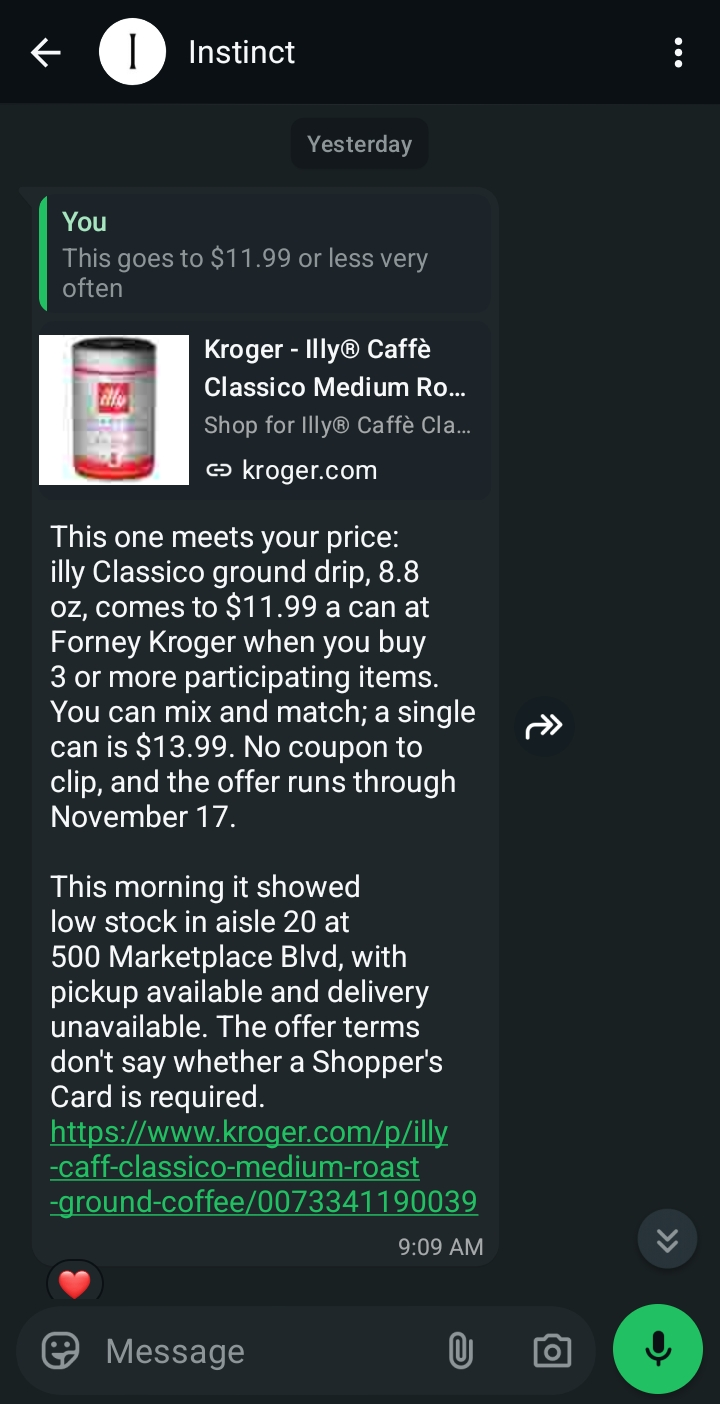
Similar to Muse, Instinct also has this habit of picking up context and following through without me explicitly asking it to set up a reminder or track them. The product I asked Instinct to track was a specific ground coffee brand. I explicitly mentioned that I was “waiting for the price to drop.” Four days later, it messaged me that the nearest Kroger had it for a dollar less.
The interesting part here is that I did not provide my location during this chat. Instinct had picked it up from my setup process, where I gave it my portfolio site (www.jkspeaks.com) and asked it to learn about me. My guess is Instinct extracted my general location from there. It does not have access to my Gmail or any other services yet.
As a follow-up to the coffee chat, I told Instinct that the price normally drops further and gave it my target price. Nothing more. It saved that information and continued to watch, in the background. Three days later, I got another notification that Kroger had the product at my target price, but a multi-buy purchase was required. By the way, Instinct is also blocked by Amazon, just like Muse for the same reasons.
Another test involved finding local contractors and handymen. If you provide high-level details like “I need a certified, highly rated electrician at this price point,” the output is no different from what a standard AI assistant would provide. However, the moment you add more specifics, such as needing someone who is insured and can also take care of X, the search gets more focused. It gets into a verification mode and takes time to research and respond. It does come back with an update in a day or two, but the output has not been stellar so far for either agent, so it remains a tie. I am yet to task them with booking the appointment or requesting quotes directly, which is next in queue.
A few other tests included generating PDFs and documents, processing images, and producing a Bill of Materials list. Instinct handled all of these, though the output quality was not consistent. Maybe the model at the backend keeps changing. One highlight, though, was its speed in analyzing image-based problems. Something I did not anticipate.
One thing is clear from my testing so far: proactive background monitoring, without needing to set up manual schedules, is becoming a baseline expectation for personal AI agents.
The Upcoming Tests
The real test begins this holiday season. I’m setting up two separate virtual credit cards, each with a hard $50 spending limit. One for Muse and one for Instinct. I’ll let them shop for small items like kids’ books, coffee, etc., and see how they perform.
If you are wondering what gave me this confidence to put real dollars in the hands of agents, I have been experimenting with agentic trading for a while now. So, moving both agents from conversation to autonomous execution is not that big a leap for me. If you are new to this, you can also follow the same virtual credit card route with limited exposure, provided your credit card company supports it.
If you are curious to try Instinct yourself, I have a limited number of invites available. Drop a comment below with one specific task you would actually hand over to an autonomous agent today. I’ll send invites to the most interesting use cases, with priority for early responses.
I’m curious to see what you’re planning to throw at it while I wait for Claude Duet access.
#AIAgents #AgenticAI #Muse #Instinct #AIExperiments #FutureOfWork #ClaudeDuet