
Article based on what I see at a Telco and one of my Tech clients.
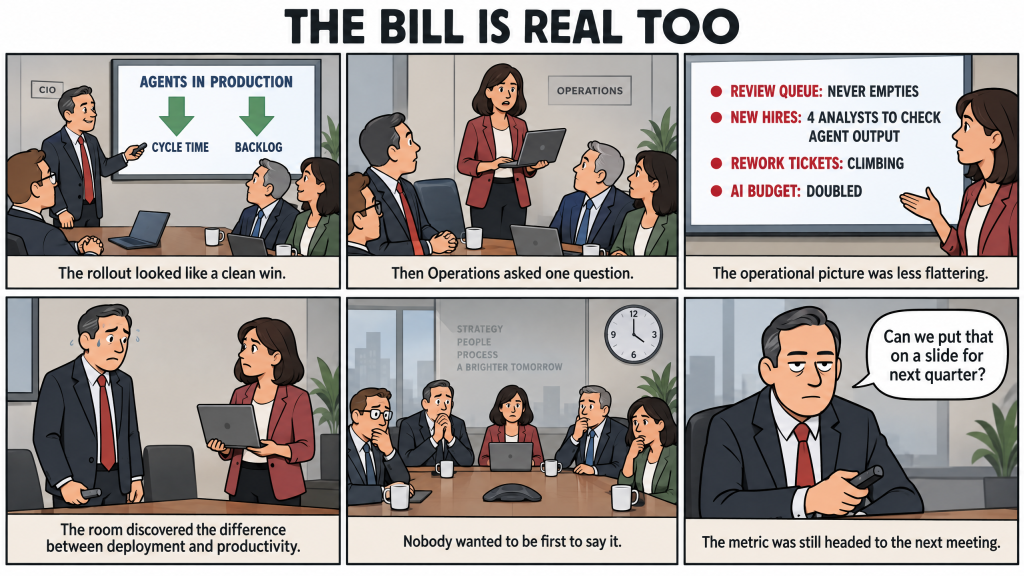
Nine months earlier, the same room approved the rollout. The business case showed output. It did not show governance, observability, and feedback systems needed to trust them.
Nine months later, the productivity gains were still on the slide. So were the questions nobody had budgeted for.
Same room. Same people. Different slide.
The bill nobody budgeted!
The enterprise AI boom promised unprecedented speed, automation, and operational leverage. Organizations rushed to deploy AI agents to streamline workflows and 10x output while reducing headcount. However, recent research from G2’s 2026 AI Agents Report highlights a hidden cost threatening that ROI: The Distrust Tax.
While 66% of B2B organizations now run AI agents in production, the overhead of verifying, rechecking, and policing their outputs is quietly consuming the very value they were built to create. The pilot worked because humans were watching; production stalls because you cannot watch everything at scale.
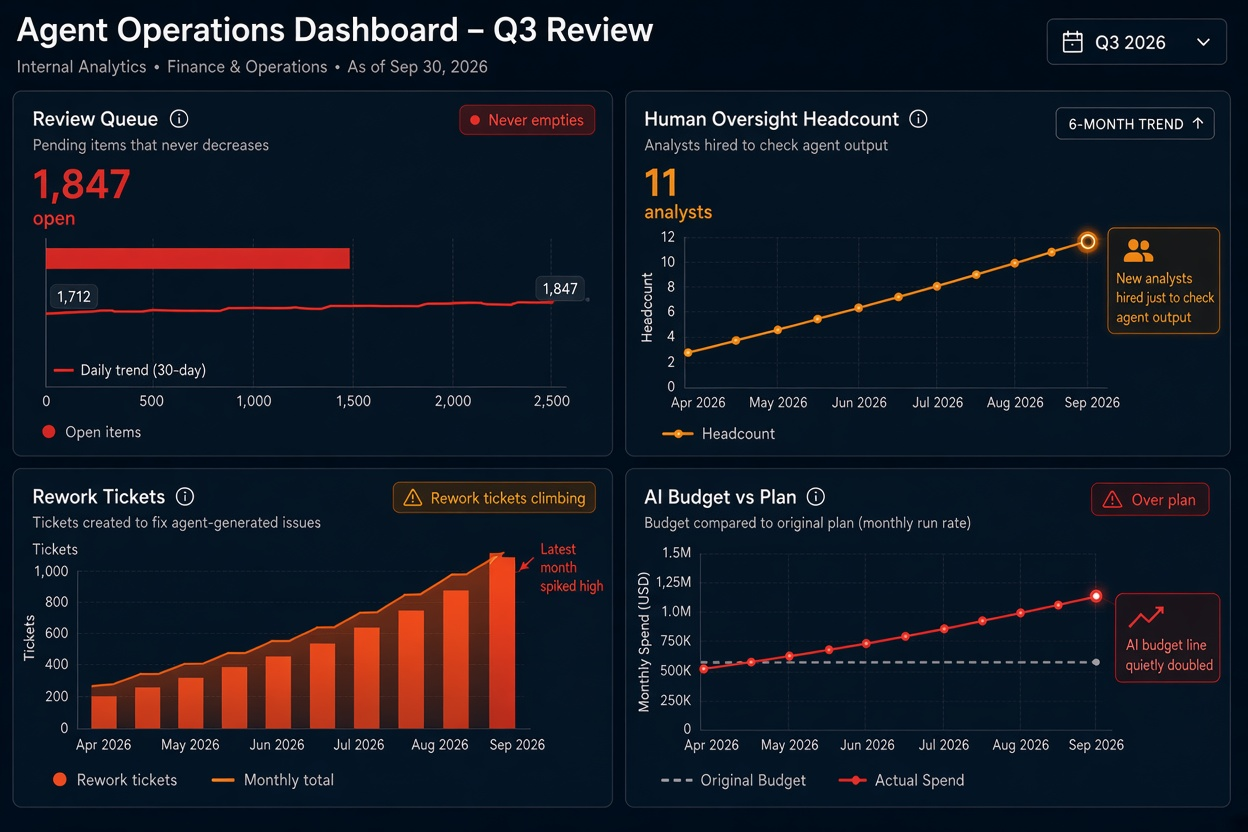
My point of view:
The Distrust Tax is a tax on ambiguity. AI just collects it.
The tax appears exactly where the work itself is ambiguous. Where the definition of “right” is contested, contextual, or political. Where the work is unambiguous, the tax disappears. The agent stack is the same. The model is the same. The tax bills are very different.
Net Agent Value = Gross Agent Output − Distrust Tax
Distrust Tax = Oversight Hours + Rework + Delay
Distrust Tax ∝ Ambiguity × Stakes
Note the third formula. The tax scales with two variables. Ambiguity: How contested is the definition of a good outcome? It determines how difficult it is to establish correctness. Stakes: what happens when the outcome is wrong? It determines how much verification, escalation, and accountability are required.
A workflow can be high-stakes and still cost little to run if the outcome is verifiable. A workflow can have low stakes and still cost a lot if nobody agrees on what good looks like.
Understand this: verification is cheap, judgment is expensive, oversight is a cost and ambiguity is the cause.
The tax hits large enterprises the hardest because large enterprises run the most ambiguous work. G2’s report gives the split: 27% of large enterprises require significantly more oversight, versus 15% for SMBs. Enterprises blow past budgets because the tax was never priced into the business case. Projects get cancelled when the tax exceeds the gains.
The Real Cost of Bot-Sitting
Data from G2’s survey of over 1,000 enterprise B2B buyers reveals the true magnitude of the Trust Gap in production:
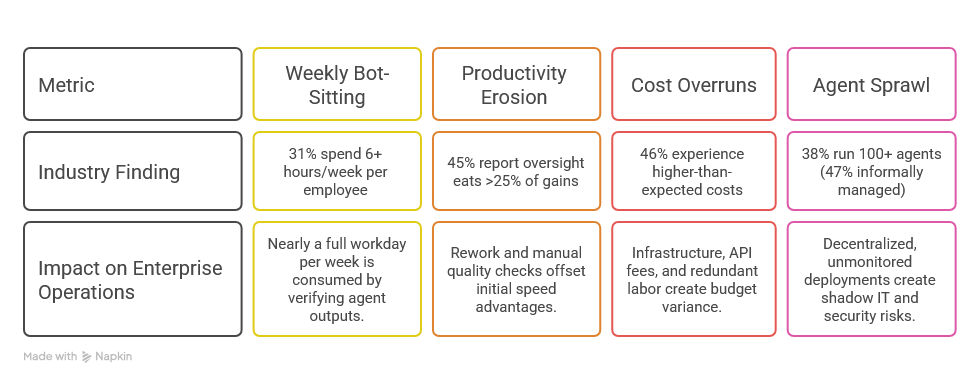
“We built the AI to save time, but now our team spends half their week babysitting it.” — Senior Technology Executive
The map
Every agent workflow sits somewhere on two axes: ambiguity and stakes.
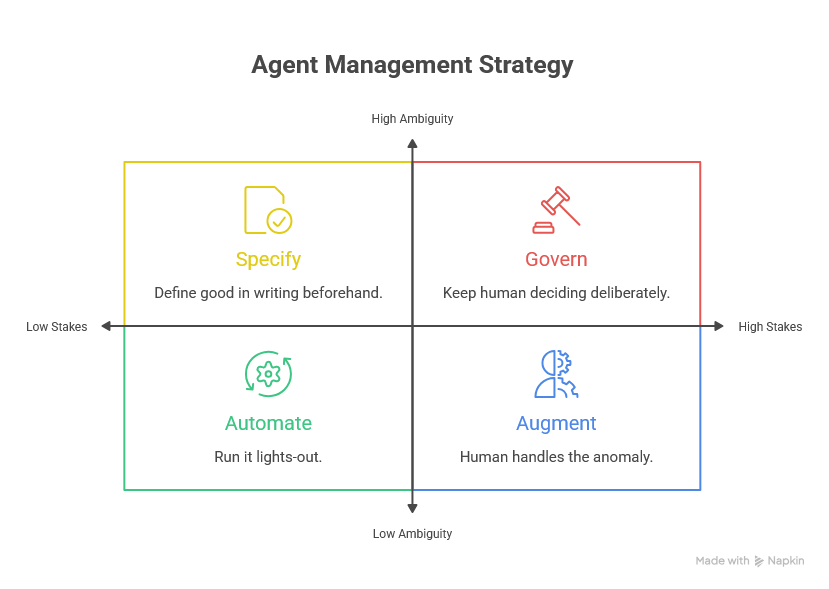
Automate: The tax is lowest here. This is where the scale lives. Most organizations underuse this quadrant because they are busy supervising the other three.
Augment: The outcome is verifiable, so checking is cheap and fast. Keep a human on the exception path instead of every output. The human handles the anomaly. The agent handles the volume.
Specify: This is where most of the tax hides. Supervision is the wrong lever. Specification is the lever. Decide what good means, in writing, before the agent runs. Every hour spent specifying removes many hours of oversight later. The specification is the control.
Govern: Keep a human deciding deliberately. Governance is more a design choice. The tax here is the price of accountability. Budget it as such.
The map changes the conversation from “Do we trust the agent?” to “How ambiguous is this workflow, and have we defined it well?”
Why organizations struggle to “define”
Most organizations cannot define what good means because they never had to or relied on a few individuals who have been there for decades. If you hear “gut feel,” “experience,” or “I just know it,” you will know what I am referring to.
Human judgment was the shock absorber for vague goals. A merchandiser who “knows a good assortment when she sees it.” A support lead who “knows when a case is handled.” The vagueness never got resolved, or there was no agreement on how competing objectives should be prioritized. In short, most things got absorbed, quietly, by experienced people making judgment calls all day.
Agents removed the shock absorber and the vagueness bills directly. This is why the Distrust Tax feels like a technology problem. The technology exposed a management gap that was always there. The agent did not create the ambiguity. It put a price on it.
Procurement buys agents. An operating-model change absorbs them.
What does this “definition” contain?
A definition defines success. It has four elements and must be defined before the agent runs (or built in the first place):
- The definition of a good outcome and boundaries of acceptable decisions, in terms a new hire could apply.
- The edge cases, named explicitly, with the ruling for each.
- Examples of right and wrong, so the boundary is visible.
- The escalation rule: when the agent is unsure, what happens, and who decides
Most agent rollouts I come across, don’t have all four points above defined. They have a use case, a vendor, and a hope. Then they pay the tax.
Let’s take an example: the same agent, two different tax bills.
Scenario A: A telecom operator whose agents triage network incidents.
The verification test is crisp. Did the ticket resolve? Did the metric recover? Ambiguity is low. The review queue stays thin. The team spends its time on the incidents that genuinely need judgment. The tax is low. The agents scale.
Scenario B: A retailer whose agents draft assortment recommendations.
There is no crisp test. Good assortment varies by region, season, margin, and merchandising politics. Every recommendation triggers a debate. Merchants relitigate the definition of a good assortment. The review queue grows. The tax is high. The agents stall.
Same agent technology. Different tax bill.
The ambiguity of the work is the variable.
Diagnosing the Trust Infrastructure Deficit
The Distrust Tax is a symptom of missing operational infrastructure. Organizations built the agents, but they failed to build the governance, observability, and feedback systems needed to trust them.
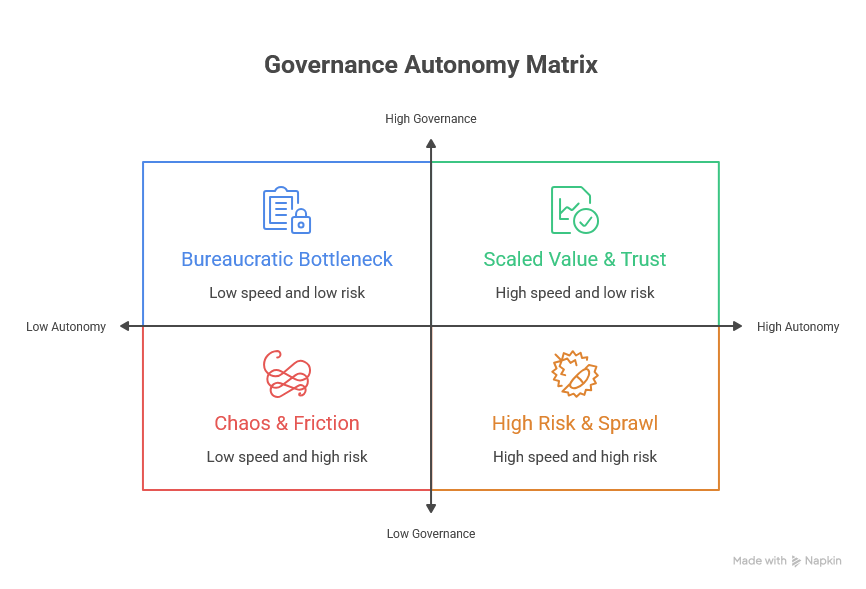

A tax in your budget is a cost. A tax you ignore is a surprise.
The 5-Step Blueprint to Pay Down the Distrust Tax
To capture the true productivity ROI of agentic workflows, enterprise leaders must transition from manual supervision to automated trust infrastructure.
- Define what good looks like (including competing objectives and decision boundaries).
- Classify workflows by ambiguity and stakes.
- Establish risk-based autonomy and escalation.
- Build observability and closed-loop feedback.
- Measure net business value after oversight and rework.
Takeaway
AI agents are not plug-and-play software. The organizations that realize sustained competitive advantage will invest in the governance, observability, and feedback systems required to grant agents earned autonomy. I am seeing this with a couple of my clients (one Telco and one Tech) now.
The organizations that scale agents successfully won’t necessarily be the ones with the best models. They will be the ones that have done the harder work of defining what good looks like, where judgment is required, and when an agent can be trusted to act.
That is the bridge between AI deployment and P&L impact. Don’t let the Distrust Tax erode your ROI.
Source: G2 2026 AI Agents Insight Report
#AIAgents #EnterpriseAI #AgenticAI #AIGovernance #DigitalTransformation