
Large Concept Models (LCMs): A Leap Beyond LLMs and LRMs in AI
Artificial intelligence (AI) has witnessed remarkable advancements, evolving from rule-based systems to sophisticated models that mimic human language. Large Language Models (LLMs), like GPT-4, have demonstrated impressive capabilities in processing language at the token level.
Early 2020s saw the emergence of Large Reasoning Models (LRMs) to tackle the limitations of LLMs in structured reasoning and logical problem-solving. LRMs have since evolved, progressing from Chain-of-Thought (CoT) prompting to graph-based reasoning and rule-based inference.
More recently, in Q4-2024, Large Concept Models (LCMs) have emerged, marking a paradigm shift by operating at a higher level of abstraction, processing entire concepts or sentences rather than individual words.
Let us do a quick comparison of LCMs against LLMs and LRMs, highlighting their advantages, limitations, and potential applications.
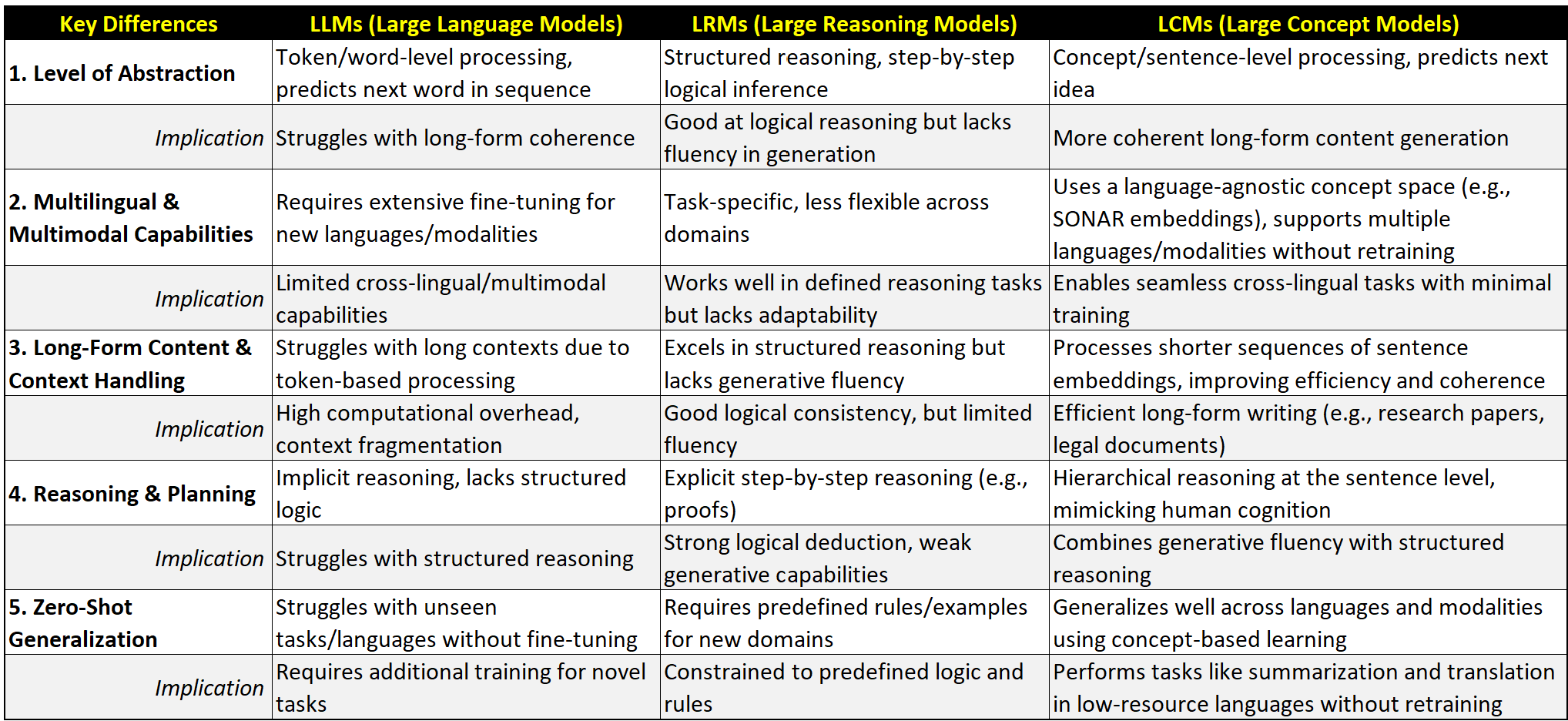
Advantages of LCMs Over LLMs and LRMs
- Better Semantic Understanding – Focuses on meaning rather than syntax.
- Efficient/enhanced Long-Context Processing – Handles extended documents more effectively.
- Modular & Extensible Architecture – Swappable components (encoders/decoders) without full retraining.
- Improved Stability – Techniques like quantization and diffusion reduce output inconsistencies.
- Stronger Multimodal Integration – Works seamlessly across text, speech, and images.
Limitations of LCMs
LCMs, while promising, present certain limitations.
- Potential bias towards shorter, informal sentences (due to training on social-media-like data).
- Loss of fine-grained word-level precision (e.g., legal or technical terminology).
- Dependence on pre-trained embeddings (SONAR), which may not capture domain-specific nuances.
- Early-stage development, with fewer mature models compared to LLMs.
Applications of LCMs
Based on the whitepapers I have read, LCMs are poised to revolutionize these fields through their enhanced contextual understanding and reasoning capabilities.
Multilingual NLP – Cross-lingual summarization, translation, and question answering.
Healthcare – Medical record summarization and multilingual patient communication.
Education – Personalized learning and automated feedback in multiple languages.
Scientific Research – Literature reviews, hypothesis generation, and interdisciplinary analysis.
Legal & Policy Analysis – Comparing regulations across jurisdictions.
Cybersecurity & Fraud Detection – Semantic anomaly detection in transactions.
Conclusion
LCMs represent a significant advancement beyond LLMs and LRMs, operating at a conceptual level to enable deeper semantic understanding and robust multilingual and multimodal processing. Despite being in early development, their potential to revolutionize AI applications requiring meaning, coherence, and cross-modal integration is substantial.
Future research addressing current limitations, such as fine-grained semantic capture and evaluation metrics, will dictate the pace of LCM adoption. Currently, they serve as a promising bridge between LLMs and LRMs, paving the way for more intuitive and human-like AI interactions.
References:
https://arxiv.org/pdf/2501.05487
https://github.com/facebookresearch/large_concept_model
#LLM #LCM #LRM