
Ambient AI Consumption: The Hidden Cost Center Emerging Inside the Enterprise
Every high-performance machine has an operating cost that surprises its owners. Claude is no different.
My hypothesis going into this was straightforward: Claude had become the de facto benchmark against which every vendor building on frontier models measures their token efficiency. Ferrari capability at Camry cost. My research confirms the spirit of that hypothesis with a critical correction that changes implications at a strategic level.
1. The Tokenizer Misconception: The Ferrari Isn’t a Gas-Guzzler
The prevailing narrative in the industry is that Claude is inherently token-hungry. A single prompt costs more simply because Anthropic’s tokenizer is less efficient.
The data does not support this. Third-party tokenization tools estimate Claude’s tokenizer at approximately 0.95× the GPT token rate on English text, making it slightly more efficient, not less. In a controlled benchmark across 2,400 enterprise tasks on e-commerce workflows, Claude 3.5 Sonnet averaged 1,219 tokens per task versus GPT-4o’s 1,847. Claude was actually cheaper per individual task because its superior reasoning allowed it to complete the work with fewer conversational iterations. In fact, for certain tasks, using Opus results in far fewer tokens and overall cost compared to running the same prompt on Haiku. This is because better reasoning can reduce total workflow cost.
In short, the fuel consumption on this Ferrari (Claude) is not unusually high. The reality is that people drive it even for grocery runs and at full throttle.
2. Agentic Complexity and the Burden of Control
The sticker shock doesn’t happen at the single-prompt level; it compounds heavily in agentic workflows.
Recent high-profile enterprise deployments tell the story. Microsoft deployed Claude Code to roughly 5,000 engineers, only to see annual AI tools budgets exhausted in months due to per-engineer costs spiking between $500 and $2,000 monthly. Uber experienced a parallel trajectory, burning through its entire 2026 AI coding budget in just four months, with their CTO reporting a single, intensive two-hour session costing $1,200, driven by the fact that 70% of their committed code now originates from AI tools.
In an agentic loop, every turn re-processes the accumulating context. In one documented session, a single 14-token question multiplied its cost by 1,339 times by message 260 purely due to system context accumulation.
The Control Gap: Ecosystem vs. Platform
To combat this “context rot,” the ecosystem has stepped in. Platforms like Glean position themselves as enterprise context layers to filter out irrelevant data and stabilize token footprints, while open-source tools like Dex use structured CLAUDE.md configurations and context hygiene to prevent redundant token burn.
The trend is further validated by several open-source repos dedicated to Claude token optimization, which document impressive gains (often 60–97% reductions) through practical engineering:
- GrepAI (github.com/yoanbernabeu/grepai): Replaced brute-force searches with local semantic search, achieving up to 97% reduction in input tokens (e.g., from ~51k to ~1.3k tokens on a 155k-line codebase) while eliminating unnecessary subagent calls.
- Claude-token-optimizer (github.com/nadimtuhin/claude-token-optimizer): Focuses on streamlined documentation and setup prompts, enabling rapid 80–90% savings in documentation-heavy contexts.
- Headroom (https://github.com/headroomlabs-ai/headroom): Compresses everything the AI agent reads (e.g., tool outputs, logs, RAG chunks, files, and conversation history) before it reaches the LLM.
While it is impressive that the ecosystem is engineering these brilliant workarounds, this highlights a fundamental gap that Anthropic needs to address directly. The demographic using Claude has shifted. We are no longer just talking about AI/ML engineers who can program custom context-compression pipelines. The frontier of AI adoption is heavily driven by non-AI engineers and “vibe coders” who have no prior coding experience. They are leveraging low-code tools, agent frameworks, and natural language to build software.
For these users, granular token management shouldn’t require an external architectural framework. Anthropic needs to provide better native, platform-level levers. For example, intuitive prompt-caching configurations, automated context-truncation settings, and transparent model-routing gates to give non-technical builders direct control over their consumption.
3. Ambient Consumption: The Trust Problem with a Cost Symptom
Beyond intensive agentic execution, a quieter, more insidious cost pattern is emerging at the product integration layer: ambient consumption from integration surface area.
Consider this feedback from Aishwarya Naresh Reganti tracking workspace integrations:
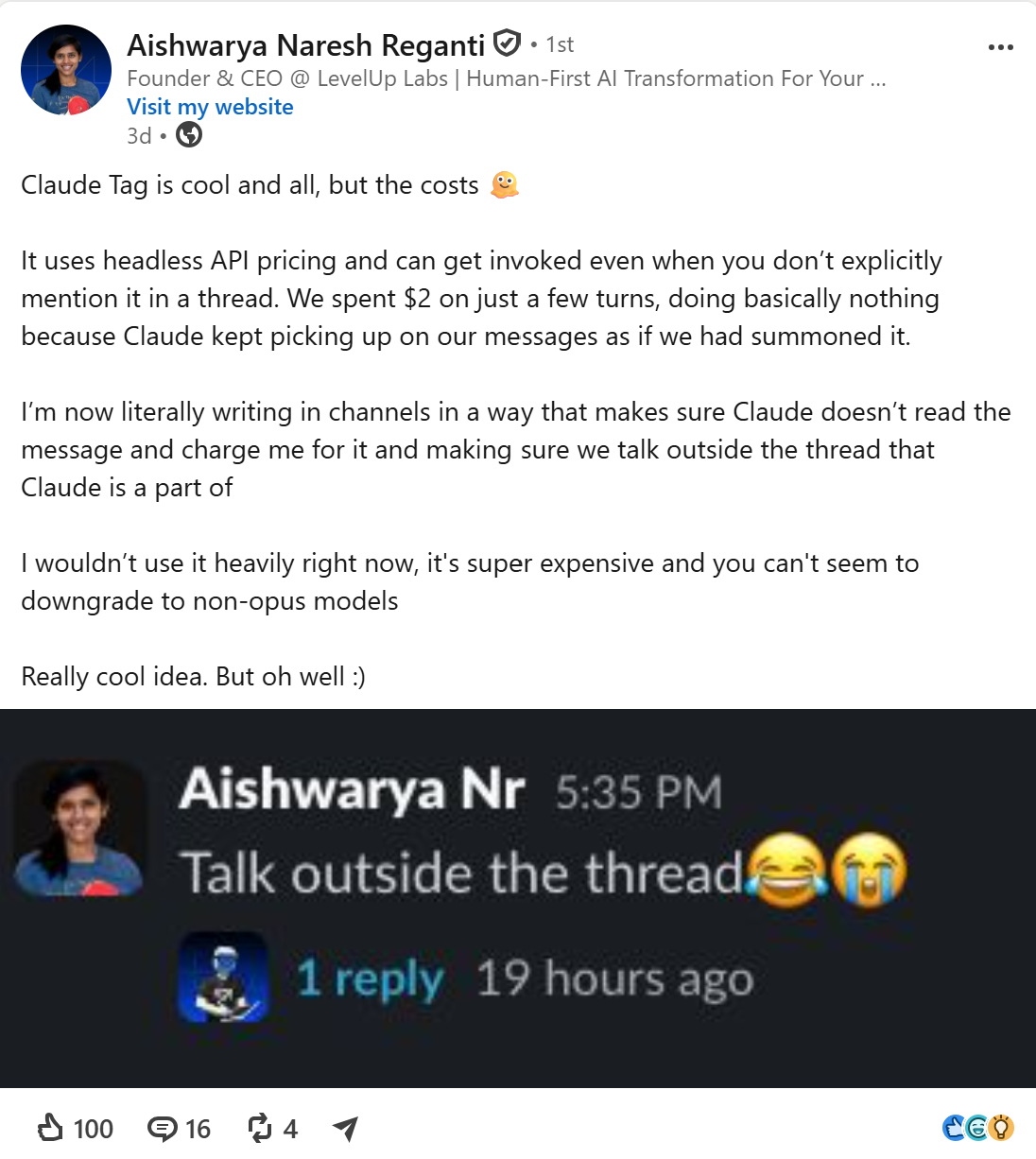
When an AI integration passively listens to ambient signals across channels or threads, every background event becomes a metered API call. The Ferrari isn’t being driven; it’s idling in the garage, burning premium fuel while listening to the room even when you didn’t explicitly ask for it.
The consequence here is two-fold. When users begin consciously altering their natural language or moving to separate channels to avoid triggering a billing event, the tool has crossed a dangerous threshold. We are no longer talking about a cost problem; it is a trust problem with a cost symptom.
What This Means for Enterprise Decision-Makers
Gartner reports that 25% of planned 2026 AI budgets are slipping into 2027, with cost surprises serving as a primary driver.
Leaders must shift their evaluation metrics along three axes:
- Look for smarter architecture, not just cheaper models: Claude’s high-end performance justifies its use, but it must be paired with intelligent platform governance. Demand visibility into how integrations manage passive triggers and ambient context.
- Measure Cost Per Outcome, not Cost Per Token: A point-in-time token price comparison is misleading. Illustrative modeling shows that at premium flagship tiers (e.g., Opus at $5/$25 per million tokens vs. competitors at $2–$2.50 input), a model that requires fewer iterations to solve a complex coding or reasoning task can actually yield a cheaper total cost per completed business outcome.
- Enforce dynamic model routing and context management: Reserve premium “Ferrari-class” models for complex reasoning and high-stakes synthesis. Routing simpler tasks to lighter tiers can yield 10× to 25× cost reductions without degrading quality. No brainer, but it would have been great if it had been handled by the model internally.
- Focus on Context Engineering and Hygiene: Either invest in complementary context platforms (such as Glean’s permission-aware knowledge graph) that reduce redundant retrieval and token overhead while enhancing security, governance, and accuracy or adopt advanced RAG, semantic retrieval, prompt caching, progressive loading, and minimal viable context structures. This is required at least until Anthropic can bring these natively into their ecosystem.
My Honest Reframe
Claude is not a Ferrari because it drinks fuel faster than other cars on the same road. It is a Ferrari because it is the machine people choose for the most demanding circuits. The driving is intensive, the workflows are complex, and the adoption is highly concentrated.
However, as the user base expands to include vibe coders and business builders who aren’t traditional software engineers, the responsibility of token optimization cannot rest solely on third-party frameworks or clever developer workarounds. For frontier models to remain sustainable enterprise staples, platform-native control must mature alongside raw capability.
Let’s see who engineers the smartest, most controlled architectures around their models first.
How is your organization navigating token governance as AI agents become a permanent part of the workspace? Are you managing the triggers or simply reacting to the invoice?
References & Data Sources
Model Pricing & Workload Economics
- Anthropic Model Pricing: Anthropic Official Pricing Documentation (Flagship and lightweight tier rates).
- Frontier Model Rate Comparisons: AI Magicx Benchmark Comparison & DevTK.AI Pricing Log (Cross-referenced vendor flagship API rates).
- Enterprise Workload Cost Modeling: Data adapted from IntuitionLabs LLM API Pricing Comparison Report. Note: Comparative scenario pricing ($180 vs. $13.50) represents synthesized calculations for illustrative enterprise document workloads based on published per-token metrics.
Tokenizer Efficiency & Performance Task Benchmarks
- Relative Tokenization Rates: MultipleChat AI Token Counter (Third-party estimation of the ~0.95× English text tokenization differential).
- Task-Based Token Efficiency: Branch8 LLM Token Efficiency Benchmark (Directional e-commerce workflow study tracking average tokens per completed task across 2,400 runs).
Enterprise Agentic & Coding Deployment Case Studies
- Microsoft Claude Code Strategic Shift: First reported by Tom Warren, The Verge (Notepad Newsletter, May 14, 2026). Corporate metrics and implementation timelines verified via Enterprise DNA Analysis (Internal memo data tracking 5,000 engineers and subsequent budget adjustments).
- Uber Enterprise AI Budget Dynamics: Statement by Uber CTO Praveen Neppalli Naga regarding coding session burn rates and AI code generation percentages, as documented by Forbes and The Information, referenced via OpenTools News Report.
- Context Accumulation Multipliers: Tracked session context compounding data sourced from IntuitionLabs Token Optimization Case Study.
- Granular Task Cost Profiles: Morph LLM AI Coding Cost Index (Granular pricing breakdown for bug-fixes vs. feature engineering iterations).
Context Engineering & Ecosystem Mitigations
- Enterprise Context Architecture: Glean Enterprise Search Evaluation Framework (Positioning of permission-aware knowledge graphs against token inflation).
- Local and Output Optimization Tooling: Directional reductions via configuration management and open-source command proxies documented via drona23/claude-token-efficient GitHub Repository and ComputingForGeeks Open Source Integration Tests.
Enterprise AI Market Trends & Governance
- AI Budget Drift & Infrastructure Performance: Gartner Market Study, as reported by The Next Web Enterprise AI Analysis (Data tracking 2026-2027 budget shifts and infrastructure delivery targets).
- Model Routing Economics: Multi-tier architectural cost-reduction frameworks analyzed via CloudZero Core Blog.
#TokenEconomics #GenerativeAI #Anthropic #Claude #AIArchitecture #AgenticAI #AI #EnterpriseAI #AIGovernance #CIO #CTO #CDO